
Monthly Archives: November 2010

The New Atheism, Fast Company, and the Integrity of Doubt

by Stephen Rodgers

Where’s Garrett?

So in case you’re wondering what happened to Garrett, he needed a couple of weeks to take care of some personal business up north. And while normally I am a very “planned plans” kind of guy (as my fiancée says), when you’ve contributed an article a week for almost a year as Garrett has done, you’ve earned the right to call your editor, tell him to cover for you, and take some time off. So instead of Garrett you get me. I’m sorry.

You’re going to be sorry too when you see how long this article is.  And since 1) Garrett gave me rather short notice, and 2) I’m the editor…I think we can safely assume that it sailed through editing without sufficient review.  Such is life.  But in the spirit of the Lord, I did not come to bring peace, but an essay of interminable length.  Plus, I’ve exercised, I’m caffeinated, it’s been a good week in the Word, and I’ve been reading a lot of Frank Turk, so I’ve “got my mad on” as the kids say these days. Or whatever they say these days.

And as anyone knows, when I get worked up about something, working it out can take a while. So use the restroom if you need to. And pack a lunch. This could take a little while.

The New Atheism

Today I want to bring your attention to the so-called “New Atheism” that we’ve all heard of. Numerous books have been written by this group, in support of this group, in opposition to this group, and about this group. The whole movement has become something of a cultural lightning rod in certain circles, which is why I think that it will pretty much burn out in five to ten years. As a whole, Western thought in the 21st century seems to have been afflicted with a rather serious case of ADHD, and the shirt that begins a rational thought and concludes with “…oh look, a chicken!” seems rather prophetic. It’s been a fun diversion, but we’re starting to lose interest and it’s time to move on to the next all-the-rage-ideology in our marketplace of ideas.

That’s not what I wanted to talk about however. And all my predictions notwithstanding, I am neither a prophet nor the son of a prophet. If we’re invoking genealogies however, my father does work for a non-profit organization.

Ok bad joke. Somewhere my fiancée is having a giggling fit. But that can be attributed to her sheer reckless joy in the wonder of wordplay that is possible in English, and how love of language covers a multitude of my sins against humor.  You may say that in this arena, I sin so that grace may abound, and perhaps I do…but again, blame Garrett, not me.

However, for those who missed it the first time around, let me give you a rather brief recap of the New Atheism, it’s notable representatives, and it’s latest contribution to the discussion among worldviews.

The Four Horsemen

The so-called “New Atheism” movement is really nothing that new, per se. A few years ago, there was a flurry of books published pro-atheism/contra-Christianity, and from this body of literature four voices emerged as the primary spokesmen. Those voices were Richard Dawkins (a biologist), Daniel Dennett (a philosopher), Christopher Hitchens (a writer), and Sam Harris (at the time, a graduate student in neuroscience who has since completed his studies). And ever since they got together for a roundtable discussion of sorts in 2007, they’ve referred to themselves (and been referred to by the media) as the “Four Horsemen of Atheism.” As an amateur apologist of the Van Tillian variety, I can’t help but facepalm in noting that even their very name is “borrowed” from the Christian scriptures (Revelation 6:1-8). Truly, as the Preacher said, there is nothing new under the sun (Ecclesiastes 1:9-11).

I’m not particularly fond of the Four Horsemen label. For one, I don’t like loaning out Christian books to people who return them with the pages smudged and the corners dog-eared, not to mention the nasty notes written in the margins. Also, with the relatively recent revelation that Christopher Hitchens is in the final stages of cancer, drawing parallels between him and Pestilence seemed rather tasteless. It is the sort of shocking reference that I would actually expect Mister Hitchens to embrace rather than shrink from, but mine would be a most uncomfortable laughter.

To my mind, the “Four Horsemen” were more reminiscent of the modern boy band than the Biblical Apocalypse. Richard Dawkins is the front man; he is the catalyst, the rallying point, and the central pillar of the group. Daniel Dennett is the deep one, the writer, the (for lack of a better word), the soulful one (and he sports an epic beard to prove it, of which I am duly jealous). Christopher Hitchens is the bad boy; in a different world I can envision him sporting sleeveless undershirts in combination with a beanie, muscled arms covered in cryptic tattoos, and adorning the posters on teenage girls’ walls. And Sam Harris…well…not to be too insulting or dismissive but Sam Harris is that other guy. Every band has one, and those of you who play in one know exactly what I mean.

But more on Mister Harris later.

The Integrity of Doubt in General

The literature of the New Atheism is often said to be bracing in its assertions. The authors do not shy away from making their claims, rather they proclaim them boldly, assert them aggressively, and even take a rather perverse joy in blasphemously sticking their finger in the eye of religion in general and Christianity in particular. And once the initial shock wears off, there is something almost endearing about this; after all, at least they are honest about it right? These are not knives in the dark; this is a gunfight at high noon.

But when one reads further, something is not quite right about their assertions. They muster seemingly-impressive arguments to justify their disbelief. Their objections seem almost righteous in their fury, and their claims that they are simply following the evidence wherever it might lead seem almost noble…but one can’t help but feel a bit uneasy.  To paraphrase the Bard, something is fishy in Denmark, and while it isn’t immediately apparent, it’s there…just beneath the surface.

It took me a while to put my finger on it, but I think I’ve finally sorted it out. While it’s easy to get carried away by their claims, there is an undercurrent of disingenuity to the whole affair. And in that understanding I was finally able to understand while after nearly five years of dealing with the fallout that this movement has produced, I can honestly say that while I have been exhausted, I have not been enriched. In other words, there is a good reason that the whole affair has made me tired, but not smarter.

You see, the whole movement, when the veneer of glamour, rage, and panache is stripped away, is empty inside. It’s a parody of the Trojan Horse: hollow yes, but the soldiers overslept and the arborous equine was delivered without its martial payload.

The Integrity of Doubt in Dawkins

Take Richard Dawkins for example. He quotes early and often the atheist argument (technically categorized under “multiple-attribute disproof”) that if God did exist, He could not possibly be both omniscient and omnipotent. After all, a God who knows the future in absolute terms is actually powerless to change it, is He not? For if He knows something about the future, and He knows it in the past, then when He eventually arrives at the time of the event in question, He’s stuck. If He knows the event, He can’t change it (and is thus not omnipotent). If He changes the event, then He didn’t really know it (and is thus not omniscient). And so Mister Dawkins crosses his arms, leans back in his chair and feels that in 30 seconds he has dismissed the question of the existence of God.

Now don’t get me wrong; this might be a great argument to use against me if I ever were to claim that I were God, with all the divine properties and human limitations therein. But who EVER suggested that the Christian God is like me? Who said that He knows things as I do, subject to the vicissitudes of space and time? The God of Christian theism is not subject to the universe He created, caught up in His own creation and along for the ride whether He likes it or not. Rather He stands over and outside it; this is precisely what we mean when we describe God as transcendent, when we speak of the Creator/creature distinction, and is even hinted at when we invoke His attribute of Holiness.

And this is no cheap equivocation on the part of the Christian; we aren’t making this up as we go along. In several of my conversations with modern atheists they have been unable to grasp the irony of mocking my “bronze age holy book” with one breath, and then faceplanting into the most basic descriptions of deity it espouses with the next. “That argument,” they will sputter, “was advanced by Plantinga, and has yet to be proven!” No friends. That argument was advanced by Isaiah (and I detect echoes of Moses in there as well) and has yet to be refuted. I realize that being fashionably belligerent is all the rage these days (another pun; the audience groans and my fiancée laughs), but please, a modicum of respect for history. We have gone over this ground before: the prophet Isaiah (Isaiah 46:8-10), the apostle Paul (Acts 17:24-28; Romans 11:36; Colossians 1:16), the church father Augustine (in his declaration the prior to God creating it, time was not)…and these men have been on record for thousands of years. There comes a point in debate when your opponent refuses to abandon a pointless line of argument, and we all channel our inner James White and finally resort to praying for patience as we repeat our mantra of “asked and answered” through gritted teeth.

And so, as a Christian theist I am forced to admit that perhaps Mister Dawkins has done some damage to the God of deism. If these arguments were assembled, put in good order, and aimed well then we might conclude that they strike the god of Spinoza. But the God of Abraham, Isaac, and Jacob watches the missiles sail harmlessly by, and were He not omniscient, would no doubt be wondering what the heck the archer thought he was aiming at.

The Integrity of Doubt in Hitchens

This is getting long, so I must move along, and so I skip past Dennett for reasons of space rather than fear to arrive at Hitchens. Now to be fair to Mister Hitchens, he is rather fun to listen to. Of all the exemplars of the New Atheism he is the cleverest, the most humorous, and far-and-away the most entertaining. But nestled among his bon mots and his scorching sentences is a rather alarming vapidity of scholarship. His book God Is Not Great betrays a rather obvious dearth of philosophical argumentation, historical accuracy, and logical reasoning.

David B. Hart goes into far greater detail on the matter, and is more fun to read as well, so I would simply recommend to you his essay on the subject. (And in the interest of giving credit where credit is due, was a source of inspiration for this essay as well).  But at the end of the day, to my mind at least, Hitchens’ objections to Christianity fail to even find Christianity in the first place, and then fail to even rise to the level of argumentation in any event. So we have arguments that aren’t against a target that isn’t…which is politely known as “nonsensical” to those in academia. Others may employ harsher language, but this is, after all, a church newsletter.

The Integrity of Doubt in Harris and Fast Company

Now you’ve been quite patient to come this far with me. I would beg your indulgence to go a little further, with the encouraging comment that, (as Henry VIII perhaps said to one of his wives), “I shan’t keep you long.”

You see, this brings us to Sam Harris and his most recent foray into the fray, armed with nothing less than an infographic. For those of you who haven’t been blessed or cursed so as to have relatives who forward a veritable bounty of these to you daily (in my family the less scholarly inclined seem fond of GraphJam, whereas the more educated have a preference for FlowingData), and infographic is simply a visual representation of some data set. If that’s still confusing, think of it simply as a “graph on steroids” and that should be a sufficient basis for moving on.

You see, all that to say that late last week Mister Harris emerged onto the scene with a graphic showing the alleged contradictions within the Bible. One writer has even crowed her triumph by crowning her endorsement of the graphic with the proclamation “So to anyone who thinks the Bible’s the last word on anything, remember this: It isn’t even the last word on itself.”

Alright…got it. Flag on the play. A claim against Biblical inerrancy has been lodged, and the ball, as they say, is in our court. But is this really a case of novel argumentation, or once again do we find ourselves well-lit and in the presence of something rather old?

Integrity MIA: Info-

First there is the question of where these objections came from. Apparently they came from someone named Steve Wells…and apparently Mister Wells has been able to put his copy/paste skills to good use in appropriating (that is the correct term, we do not say “stealing” when it comes to works of literature and art!), the very same questions raised by the Skeptic’s Annotated Bible (see here and here). For those unfamiliar with the work, it is pretty much exactly what you would expect given its name: a series of objections and questions to the Bible, often relying on an overly-literal hermeneutic of some kind, in annotated form.  And just to muddy the waters further, it typically uses the KJV, but that’s another issue for another day.
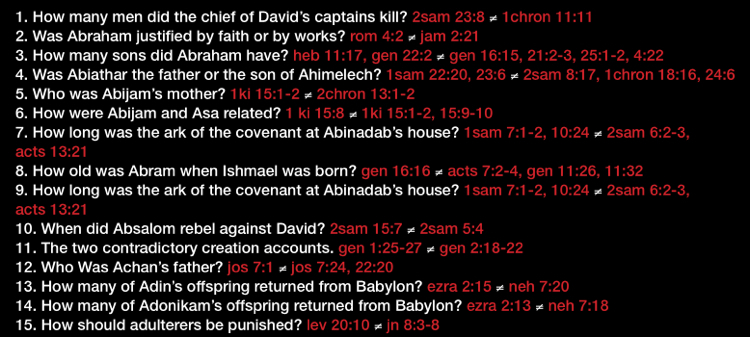
Now please understand, my point here is not to fault Mister Wells in using a readily available set of data. And to be fair, it doesn’t seem to be an exact match since the graphic in question cites 439 alleged contradictions and the latest version of the SAB cites 457. My point is simply to show these are not new objections; they have been asked before, they have been answered before, and this whole exercise is one in retracing our steps rather than boldly going where no man has gone before. And more to the point, the SAB at least has the intellectual honesty to link to a fair number of Christian explanations and refutations regarding these alleged contradictions. (And I do emphasize “alleged” since a large number of them can be resolved simply by restoring one or both verses to their context, and then reading them there). In fact, the SAB is sometimes used in seminaries to underscore the importance of hermeneutics; it’s not considered a strong argument raised against inerrancy (at least, properly understood).

Alright, so at the very least this presentation is predicated on specious argumentation and a lack of intellectual charity. After all, as the late Dr. Greg Bahnsen observed, when your opponent presents an argument that can be understood in either a weak or strong sense, it is incumbent on any scholar wishing to preserve their integrity to deal with the strongest possible form of the argument. Otherwise at best you are a coward, and at worst you’ve committed the logical fallacy of arguing against a straw man.

But does it end there?

Integrity MIA: -graphic

You see, as I observed earlier in my essay (we’re being charitable remember, so let’s call it an essay), that I am both a Van Tillian in my apologetic orientation, and an artist/statistician by training who is often besieged by emails from well-meaning family members containing just such infographics. And while those might seem unrelated, they converge precisely at the point of Mister Harris’ allegedly-novel presentation (alternatively described as “stunning” and “provocative”) of alleged Bible contradictions. And since my theological betters have already addressed the issue of the contradictions well enough (see contributions from Justin Holcomb, Douglas Wilson, and Matt Perman…which interestingly enough pretty much covers a decent range of my theological library as well…if Phil Johnson wades into the mix I’ve got a complete set).  There may be others; that’s merely what I found in the first 24 hours.  That leaves very little for me to deal with, except the “graphic” part of the infographic. But I have a BA in Visual Arts…sort of…and so with sketchbook in hand and beret perched at a rakish angle, into the fray I go.

Now, the design of the graphic itself is attributed to Andy Marlow. But it seems rather familiar to me…probably since I wrote about one suspiciously similar back in January. This has been done before. It has been done better, and ironically enough, it has been done by Christians. And so, interestingly enough, we have a very real example of atheism propping itself up on borrowed capital. However, lest I mistake charity for lying, it is worth noting in passing that when the capital is borrowed without the original artist’s knowledge, we call that “stealing,” and when the capital is abstract and epistemic or artistic in nature we call that “plagiarism.”

Oh.  Oh dear.

Now to be fair, do I have any real evidence that Mister Marlow simply stole Mister Harrison’s work, made a few minor changes, and is now passing it off as his own?  Well, again in good presuppositional fashion, that is going to depend entirely on what sort of propositions you accept as “evidence” in the first place.  If you are asking if I have video evidence of Mister Marlow talking aloud to himself about how the inspiration of his work came from elsewhere…then no.  If you are wondering if perhaps certain emails have come into my possession wherein he admits to having prior knowledge of the original piece, and elects to use an almost-identical style without attribution…then no.  However, I do have two perfectly good eyes, and when point out that this is Mister Harrison’s work from at least ten months ago, and this is Mister Marlow’s work from last week…well, decide for yourself.  To my trained eye, the appropriation seems completely obvious.

Integrity and Lack Thereof

Part of the oft-referenced title of this piece is “the integrity of doubt.” I originally latched onto that idea in confronting the claims of the New Atheists that their doubt and disbelief stemmed honestly from their examination of the evidence available to them. Some of you might realize that as a Van Tillian I already reject that notion on Biblical grounds, while conceding the possibility that perhaps, in their self-deception, they believe it to be true. As I showed several times, this “doubt” is not really doubt at all; what they disbelieve is not what the Christian believes. They have not refuted Christian theism so much as they have simply failed to understand it.

In his letter to the Corinthians, the apostle Paul writes “Where is the one who is wise? Where is the scribe? Where is the debater of this age? Has not God made foolish the wisdom of the world?” (1 Corinthians 1:20) Simply put, it is an open challenge: if you want to go head to head with God, then show up and do so. Step into the ring. And like Job, (I’m paraphrasing here), you will find that in the end, your arms are simply too short to box with God.

The New Atheists act like prizefighters. They strut around, chests puffed out, flexing impressively. Oh sure, they talk a good game. Initially they sound dangerous. On paper, their record seems good. And we start to wonder if when they finally get into the ring, if perhaps God might be in a bit of trouble after all.

But they never get in the ring. They run around the ring. They shout insults into the ring. Occasionally they may even climb into some other ring and administer a beatdown to some lesser conception of deity. But they never actually fight the Christian God; He is evaded, He is made fun of, but He is never actually engaged.

But this comes to a head of sorts in this latest offering from Harris. All manner of problems are both inherited and invented here. You see, it is one thing to exhibit shoddy scholarship in selecting your data set. And into that general realm of intellectual feebleness I would include things like broadly construing words like “contradiction,” and ignoring elements of the case that undermine your argument like context, metaphor, and genre. But it is something else entirely to blatantly rip off another’s work without even passing attribution. As someone instilled with a particular form of academic ethos, I am outraged; in respectable scholarly company, this is simply not done. And as an artist, I can’t help but notice that it is also utterly unnecessary. After all, atheism in general and the New Atheists in particular have a history of using traditionally Christian forms of argument in a satirical and subversive way. I may not always enjoy or appreciate their doing so, but when done so honestly, it is a valid form of expression. However, this is not satire; this is lying.

And all this brought to us by the so-called “Horseman” whose most notable academic work is in the area of morality and ethics. I trust the irony is not lost on you.

Update: The Fast Company page now contains a line stating “Inspiration: Chris Harrison.”  It’s about the bare minimum that could be done in terms of attribution, but at the very least, they have now done that.

Editor’s Note: An updated version of this article was featured in the journal “In Antithesis.” More information can be found here.

Is Marriage In Your Future?

by Elder Peter Lim

Growing up in the mid-1970s in the San Fernando Valley, a suburb of Los Angeles, a familiar scene repeated itself every school day as it does even today in much of the World. We played kickball. It always began by some mob-mentality decision made by the more vocal kids that the top two athletes be the two team captains so as to avoid both of them being on the same team. I hate to brag but I was oftentimes one of the two. So the process continued where we alternated picking members of our teams until everyone was on one team or another. I didn’t consider at the time what it must’ve felt like to be one of the last ones chosen, or even being the very last one. I hope I didn’t cause any kid to cry himself to sleep at night because of my attitude toward him.

I bring back this memory (painful no doubt to some of you) because the grown-up version of this scenario can happen to many single Christians, particularly those who are hitting their upper 20s or older and there seems to be no prospect of marriage or even a relationship anywhere in the near future. To be sure, they have been well-taught (at least in our church I hope) that they need to be patient, to trust in God’s sovereign timing, etc. However, I still remember what it felt like when I was single that although I was trying hard to grow spiritually, it was difficult to find someone that I was attracted to who would also be attracted to me. It felt like other guys were being picked to be on a team and I was being left behind. Understanding that I needed to be a man and take the initiative, I worked up enough courage to ask someone to be my girlfriend. Apparently I took her completely by surprise even though we had been good friends, sometimes spending 5 out of 7 nights of the week doing stuff together whether it was studying or going to Bible study together, etc. It took her 48 hours to get back to me with the sisterly reply, “I never saw you in that way. You are a good brother to me.” I was and am grateful that she was direct and to the point but it was still unpleasant to have my feelings unreciprocated. To this day, she is still a good and dear friend. Why do I bring up this embarrassing story? Because many singles are having similar experiences and thoughts regarding the future.

Many of the guys can relate to the situation I just described. It’s not easy to put all your feelings out there all awkwardly like that just to have it rejected, no matter how kindly it was done. Especially if you are working hard to be Godly and you are asking out a girl who has a Godly reputation, you would expect that you stand a better chance of success because she wouldn’t give lame reasons for rejection. I think ladies have it even harder than the guys because as men take the initiative to be “team captains,” the ladies are often left to wonder what’s in store for their future, whether they will ever be picked to be on the team. “Will anyone ever ask me out?” “Why do the wrong guys always seem to show the most interest?” “This guy is asking me out but I’m kind of interested in this other guy…what should I do?” “Is it okay if I ask a guy out?” “Maybe I should drop some obvious hints that I’m interested in him?” Oftentimes the harsh reality of sinful Christian men, who are just as shallow as the rest of the world, as they value physical attraction more than spirituality, discourages ladies such that it tempts them to have a low self-image, self-consciousness, and even depression.

Men:

  • There is nothing wrong with video games or sports or [insert hobby here] but consider that there are other more important things to do with your life. Beware of the “Peter Pan Syndrome.” Grow up into Godly men and stop being little boys.
  • Stop looking for the perfect woman. Strive to BE the perfect man. If you found the perfect woman, what makes you think you would be worthy of her?

Women:

  • You are precious to God. He died to save and redeem you. This should define your worth and not any relationship with a man or lack thereof.
  • Don’t blame men if they are being lame. They are in the process of sanctification too. Your pursuit of Godliness should not be dependent on their growth.

Both:

  • Value the things that God values in a person. Change your own definition of “attractive” to align with God’s values. Really, do you think some movie star/model/musician/non-Christian is more attractive than a Godly person? If so, your definition is based on worldly values and needs correction.
  • The Bible never promises that those who are Godly will get married someday.
  • The Bible never portrays marriage as the goal in life. Singleness is even preferred for those to whom it has been given. (1 Cor. 7)
  • If you get rejected, don’t have the attitude of “God must have someone better than him/her in store for me.” This is not only not-Biblical, it’s prideful, mean-spirited, and even retaliatory toward the person who rejected you. It is better to think “If it’s His will for me to be married, He has chosen someone perfectly suited for me.” You will need to make an extra effort to renew your friendship with this person especially in the near future because it’s awkward for them to respond to you in this way too. Affirm them for being courageous enough to be honest in this difficult situation.
  • Do you want to be the perfect man/woman? A big hint can be found in James 3:2. This applies to ladies too. Remember that the focus is on the source of the words, the fountain from which the water comes out. (James 3:11)
  • Men, close your eyes and imagine 20-30 years into your future. Imagine that you have a daughter who has just told you that so-and-so has asked her to go out with him. What do you imagine him to be like ideally? What sort of character qualities would you like him to have? Now come back to reality and BE that man. Ladies, reverse the situation and imagine that you have a son…
  • Marriage is sometimes not easy. Remember that two sinners are coming together to form one unit. Practice your disciplines now to be self-sacrificial in your service to one another. As you serve humbly and sacrificially, you will notice that there are others who are doing the same. These should be the most attractive people to you.
  • Have you considered that perhaps it’s by God’s mercy that you are not in a marriage relationship? God may not be through preparing you for marriage yet and sparing you from difficult situations that you are not ready for. Keep praying for growth and perhaps even opportunities for you to be stretched in dealing with difficult circumstances.
  • Celebrate this phase of your life! You may not be able to fellowship with and enjoy the company of the opposite sex and learn about their peculiarities forever. It just wouldn’t be appropriate after you get married.

Do As Thou Hast Said

by Charles Haddon Spurgeon

From 2 Samuel 7:25

God’s promises were never meant to be thrown aside as waste paper; He intended that they should be used. God’s gold is not miser’s money, but is minted to be traded with. Nothing pleases our Lord better than to see His promises put in circulation; He loves to see His children bring them up to Him, and say, ‘Lord, do as Thou hast said.’

We glorify God when we plead His promises. Do you think that God will be any the poorer for giving you the riches He has promised? Do you dream that He will be any the less holy for giving holiness to you? Do you imagine He will be any the less pure for washing you from your sins? He has said ‘Come now, and let us reason together, saith the Lord: though your sins be as scarlet, they shall be as white as snow; though they be red like crimson, they shall be as wool.’ Faith lays hold upon the promise of pardon, and it does not delay, saying, ‘This is a precious promise, I wonder if it be true?’ but it goes straight to the throne with it, and pleads, ‘Lord, here is the promise, ‘Do as Thou hast said.” Our Lord replies, ‘Be it unto thee even as thou wilt.’

When a Christian grasps a promise, if he do not take it to God, he dishonours Him; but when he hastens to the throne of grace, and cries, ‘Lord, I have nothing to recommend me but this, ‘Thou hast said it;” then his desire shall be granted. Our heavenly Banker delights to cash His own notes. Never let the promise rust. Draw the word of promise out of its scabbard, and use it with holy violence. Think not that God will be troubled by your importunately reminding Him of His promises. He loves to hear the loud outcries of needy souls. It is His delight to bestow favours. He is more ready to hear than you are to ask. The sun is not weary of shining, nor the fountain of flowing. It is God’s nature to keep His promises; therefore go at once to the throne with ‘Do as Thou hast said.’

1.15a

LBC Weekly SPARK – November 12, 2010

by Pastor Patrick Cho

Dear LBC Family and Friends,

I hope you are doing well and walking in the Lord. What a blessing this past weekend was with our All-Church Retreat. I’ve been hearing from many of you that you were challenged and encouraged by the messages by Jonathan Leeman. I’m so glad to hear that! Let’s be careful not to let that be merely a nice retreat experience. Now that
we are getting back into our regular weekly services, it will be important to reflect on what we learned at retreat in order to put the principles into practice.

For those of you who weren’t able to go to the retreat, the messages and Q&A time from the retreat can all be downloaded from the church website. I would encourage you to listen to them. I also would recommend all to pick up a copy of Jonathan’s book, The Church and the Surprising Offense of God’s Love, if you haven’t already done so. It is a tremendously helpful book, and perhaps the best book on church membership that I have read.

In His grace,

Pastor Patrick

Here are the announcements for this week:

  1. Friday Night Bible Studies. Don’t forget that our Friday night Bible studies are back this week for our Youth, College, and Singles Ministries. The youth and singles will meet at the church at 7:00pm. The collegians will also meet at 7:00pm, but on-campus at SDSU and UCSD. Information about College Life rides can be found at our website.
  2. Membership Class. We will be having our next membership class this weekend, November 13-14, at the church. The two-part class will be on Saturday from 9:00am-12:00pm, and Sunday from 1:00-4:00pm. Both sessions are required for membership. If you are interested in becoming a member, please contact Pastor Patrick for an application.
  3. Communion. Since we were at retreat this past weekend, we will be having our communion service this Sunday during our regular service. Please come having prepared your hearts to worship our Lord.
  4. Thanksgiving Potluck/Vision Quest. On Sunday, November 21, at 5:30pm, we will be having our next Vision Quest event. This will be our annual Thanksgiving Potluck dinner. Signups for the potluck will be taken this Sunday by Suzie Park. Please sign up to help ensure that all the food will get prepared. Also, as it is Thanksgiving, take some time to reflect on what you are thankful for and be prepared to share with one another. Come out to our Vision Quest event for some great food and fellowship, and to learn more about the Mission of LBC.
  5. Operation Christmas Child. Each year we participate with Samaritan’s Purse to encourage children all around the world and help spread the gospel message. Fill a shoebox with various toys, socks, toiletries, etc. and bring it to church on Sunday! More information about what can and cannot be included in the packages can be found at their website (www.samaritanspurse.org). This Sunday before service will be our only collection date for OCC, so be sure to put a package together and drop it off! Contact Mrs. Grace S. Lee if you have any questions (gracelee357@aol.com).
  6. Christmas Concert and Service. Our Christmas Concert will be on Saturday, December 11 at 6:00pm. Please invite your family and friends to join us for some good music, drama, and food. It will be a great opportunity for them to hear the message of the gospel. Our special Christmas Service will be on Sunday, December 19. This also will be a great time to reflect on the gift of Christ.
  7. Mission Bowl. If you are interested in playing on this year’s Mission Bowl flag football teams, please contact Abram Kim if you are a guy, and Randy Tsuchiyama if you are a gal. No experience is necessary! Just come with a humble, teachable heart. This is a great chance to get to know your fellow brothers and sisters in Christ better and to get some exercise as well!

Weekly Links (11/12/2010)

by Stephen Rodgers

Well, welcome back to another edition of the Weekly Links. That means we’ve made it to Friday once again. I hope you’ll enjoy and reflect on the following as you finish your week and start to get ready for Sunday.  Just to keep things interesting, I’ve broken them up thematically for you again this time.

CHURCH & GOSPEL

  • Starting everything off, here’s a short video from Joshua Harris on what our attitude and behavior should be like as we come to church. (VIDEO)
  • Over at the Resurgence, Russell Moore asks a bit of an odd question: do our church testimonies empower Satan? His exploration of our perception of testimonies is very insightful.  (WEB)
  • And since we’re on the subject of things that happen in church, the Biola blog has a good article on the nature of worship music in church today in their article “Weightier Worship.” They explore the issue of what music and singing are supposed to do and point us to, and what they’ve been reduced to instead.  (WEB)
  • A few weeks ago, the weekly links had a couple of articles on how to disagree with people. For anyone who did NOT read that and now find themselves in severe interpersonal conflict, here are 15 reminders/Biblical principles as you navigate the conflict. (WEB)
  • Jon Acuff has a helpful reminder about the target of the Gospel in his post “Getting the Bus All Wrong.” And since it’s Jon Acuff, he also talks about doughnuts. (WEB)

SOCIAL MEDIA & DIGITAL LIFE

  • Over at the Desiring God blog, they’ve begun a series on the consequences of multi-tasking. If this is something that you’re interested in, you might want to check it out. (WEB)
  • And meanwhile, over at GTY, John MacArthur has an excellent article on some of the concerns and pitfalls of the digital life. I think he raises some incredibly valid points, made all the more interesting because I’m pretty sure the GTY staff had to print out all those articles for him.  I say this without mockery since Pastor MacArthur used to be my pastor.  Some might say that invalidates his arguments, but I don’t think so; I think this is about as close to an unbiased opinion based on Biblical truth that you can get.  (WEB)

PRISON

  • Over at PyroManiacs, Dan Phillips has a post on how criminals, convicts, crime, and conversion should influence our understanding of the Gospel. (WEB)
  • Stand to Reason has a quick retelling of their experience in visiting a prison. The Resurgence tells a similar story. (WEB)
  • I thought I had already posted this, but apparently not.  Not too long ago, John Piper visited, preached, and did a Q&A at Angola Prison. The sermon where he discusses it is not available on their website, but John MacArthur did the same, and is actually personally financing a theological library for them as well.  So please remember these Christian brothers and sisters in jail who are trying to use their incarceration to further the Kingdom. (WEB/AUDIO/VIDEO)

That’s all for this week.  See you Sunday!

Pro Rege

Fall Festival

by David Ahn

It seems the holidays come sooner every year, so don’t forget to be planning your costume for next year’s Fall Festival! On Sunday, October 31st, the Children’s Ministry hosted an event, but it definitely wasn’t just for the children. It ends up being a spectacle every year, where LBC-ers of all ages gather together for a memorable night of fellowship in the form of candy, games, and costumes.

The Fall Festival serves as an alternative to Halloween, selecting its best traditions, leaving out its more questionable aspects, and infusing genuine fellowship and an appreciation for the common bond that we share through the gospel of Jesus Christ. One of the first highlights of the evening are the decorations, where members of the church take time throughout the days leading up to the event to transform the church to fit a theme. In past years, the church has been transformed into Candyland, a Dr. Seuss-like world, and even intergalactic space. Behind the scenes of the decorations, the great effort and teamwork required to make these themes come alive always serves as an excellent service opportunity for church members. If you haven’t participated in the planning for Fall Festival in the past, I’d highly recommend joining in the future, as I consider it one of the hidden gems of service opportunities at our church.

On the night of the event, there are multiple booths and activities taking place throughout the church building. These stations typically include carnival-like activities (eg. Balloon Popping), video games (Nintendo Wii), and crafts/activities (eg. Face Painting). Meanwhile, there is a steady flow of delicious foods and snacks, and handfuls of candy are distributed as prizes for participating in the various booths.

Later in the evening is my personal favorite: the costume contest! The format changes from year to year, but there typically are costumes handed out from judges for a wide-ranging list of categories. In the past, the categories have included Best Individual, Best Duo, Best Group, and Best Under Budget. The judges also try to segregate the prizes by age range as well, to ensure that the adults and children have equal opportunity to win. In past years, the quality of costumes have been refreshingly high, so I would highly suggest coming dressed to impress. Many a newcomer has come out to Fall Festival to feel shamefully underdressed. Some guidelines for costumes, however: please keep the costumes appropriate (no scandalous, cross-dressing, or horrifying outfits). This leads to more creative costumes, less nightmares for the children, and less embarrassing photos being posted on Facebook.

Also, don’t forget that there is a new tradition that was started at this year’s Fall Festival. There was a pumpkin-carving (and mini-pumpkin decorating) contest, so break out your carving knives and your clever ideas for next year. Knowing the creativity and joyful execution that our church members have, I look forward to being as wowed in the years to come as I was this year.

Living Theology #45 – Church Government (part 2)

by Garrett Glende

We left off last week having discussed the roles of the leaders of the church and how the government within the body is structured. However, there was not much to do about the practical application of this issue, so we will pick up with that here. Most of the following ideas come from the book The Trellis and the Vine, by Colin Marshall and Tony Payne. If you haven’t picked it up yet, I highly encourage you to do so, as the issues they bring up have been immensely beneficial for myself and for the church in San Jose.

Since we know from last week’s study that there are certain distinct leaders within the church, the next question might be: where does that leave everyone else? If the role of the pastor is to teach the word and shepherd the flock, then is everyone else less important since we don’t have a formal title? As the authors suggest in The Trellis and the Vine, there must be a ministry mind-shift that takes place among the congregation so that each member is doing what he or she should. The first step towards achieving this goal is the recognition that we are all to be ministers of the Word. This is not a job for only the pastors, elders, and evangelists. In fact, if it were left up to them only, there would not be enough time in the day for everyone in the body to be ministered to. So, every member of the church holds the responsibility to minister to one another. This is the only way that the church will truly see growth in people’s lives.

The true job of the pastor is to train up others around him so that more and more people are equipped to minister one another. As these men and women are trained, they can train others as well. Thus, the amount of people in the church that are available to effectively minister the body is increased. Paul writes in Ephesians 4:12-13 that the leaders of the church have been gifted in order “to equip the saints for the work of ministry, for building up the body of Christ, until we all attain to the unity of the faith and of the knowledge of the Son of God, to mature manhood, to the measure of the stature of the fullness of Christ.” God has structured the church in such a way so that all of the saints might take part in “the work of ministry, for the building up of the body of Christ.”

This attitude is in contrast to one that thinks church growth is a number to be measured. It’s very easy for us to see activities and events spring up and mistake it for true growth. This is true for the church as a whole, but it is also true for our own individual lives. We must not think that we are growing in our walks with God just because we are involved in a handful of activities going on at church. Paul’s definition of growth does not include “ministry involvement,” but he rather calls for “knowledge of the Son of God [and] mature manhood.” In order to grow spiritually, we must increase in our knowledge of Christ. This is to take place as each member of the body ministers the Word to one another.

The direct application of this idea is simple. We need to speak God’s word to one another. If you’re wondering how you can serve in the church, but don’t see any specific “ministry” to join, just talk to people. Build relationships with other members so that you’re in a position to minister to them in a real way. If the whole church is committed to this principle, then the pastor’s job becomes much easier and the body will experience true gospel growth.

The Practice of Church Discipline (part 1)

by Pastor Patrick Cho

The practice of church discipline in its specifics will probably differ some from church to church. The leadership of each church needs to determine the exact process by which a member who falls into unrepentant sin is removed from fellowship in accordance with biblical guidelines. Many object to the practice of church discipline because they see it as unloving or cruel, but the Bible offers the exact opposite description. Church discipline is a necessary practice if a church truly loves and cares for its members, and seeks to uphold the name of Christ and the purity of the church.

Jesus gives some basic instructions in Matthew 18:15-17. Before looking at the passage, it is worth noting that this is the second mention of the church in the book of Matthew. The first was in Matthew 16:18, where Jesus tells Peter that He would build His church. There He announces the coming birth of the church, and the very next mention of the church in chapter 18 has to do with the greatest threat to the church, which is sin. Jesus knew the danger of people falling into unrepentant sin. He not only proclaimed the establishment of the church, but also provided instructions for the protection of the church.

Going back to the text of Matthew 18, the first step in dealing with an erring brother is private, personal confrontation (v. 15). Jesus says that if you see your brother in sin, you go and confront him alone. The text is emphatic that you are not to bring in anyone else. If you have seen the fault, you go and make it known – between you and him alone. You do not go and talk to the pastor. You don’t consult your friends. You talk to them alone. One reason for this private confrontation is that there might have been a misunderstanding. It would be unwise to involve other people and bring undue shame upon an individual if the accusations were false. If the brother has committed some sin, you are to go and plead with him to repent and turn back to Christ.

The second step in dealing with the brother in sin is to take one or two witnesses with you (v. 16). If you have done all you can to correct an erring brother and he still refuses to repent, it is necessary to bring in others to assist you. These others help not only by serving as witnesses “that every charge may be established,” but also to aid in the pleading for repentance. This is why the next verse indicates, “if he refuses to listen to them.” The small group appeals to the sinning brother to see his wickedness before God and repent. The witnesses also serve to confirm the accusations to prove that it isn’t just a misunderstanding or a false accusation.

The third step is to take it to the church (v. 17). This comes after the previous attempts to win this brother over. If you feel like your personal confrontation is not getting anywhere, you bring in one or two witnesses to help in the appeal. If they do all they can but still have the brother refuses to repent, you then take the matter to the final authority, which is the church. The church then becomes the last line of defense for the individual, and seeks to call the brother to repentance. In all three stages, this is obviously a loving appeal, but one can see how the pressure increases with each stage as more and more are brought into the situation.

It is essential to see that the goal of this process is restoration and reconciliation. The goal is not to kick the brother out of fellowship, but to win him back and help him turn from his sin. The motivation behind it all is love! If you really care about a brother who has fallen into sin, you wouldn’t want him to continue in that sin. His sin does damage to his relationship with God and others, and you want those relationships to be good. You wouldn’t want his life to be offensive to God, but pleasing. This is why you go through this process. It isn’t just to show someone how lame they are or to get back at them for hurting you. The motivation is love.

Next time, we’ll take a look at what happens if they persist in their sin, how this process was exemplified in the early church, and how specifically we apply this at LBC.

Weekly Links pt. 2 (11/8/2010)

by Stephen Rodgers

Hey everyone.  As promised last week, here is part 2 of the weekly links.  Hopefully they’ll be an encouragement to you this week until we can get together again on Friday!

  • Here’s an easy one to get you started…Al Mohler talks about reading. (VIDEO)  It’s comforting to know that childhood-Mohler and childhood-me have something in common; unfortunately it’s the fact that we both prioritized reading over obeying our parents.
  • I don’t agree with everything that Peter Kreeft writes, but this quote about the Christian’s view of Heaven is spot on. (WEB)  And before you ask…no.  That is not a picture of Peter Kreeft.
  • You didn’t think that I would let the week go by without giving you a dose of Paul Tripp did you?  It’s not really Halloween-themed, but the timing is appropriate.  So without further ado, here is his article on Christian living entitled The Costume Kingdom. (WEB)
  • And on a related theme, over at the CCEF blog, Ed Welch has a great article on the issue of Living Publicly. (WEB)
  • So…Kevin DeYoung writes a book about the Heidelberg Catechism.  CJ Mahaney reads said book and appreciates it (I haven’t read it yet, but from having read four Pastor DeYoung’s other books, I imagine it’s fantastic).  So he challenges his friend Curtis Allen…aka Voice…to write a rap song about it.  So, may I present to you, the first ever rap song about the Heidelberg Catechism. (AUDIO)
  • I have long maintained that two of the best things that Dan Phillips (of TeamPyro fame) ever wrote were a couple articles on prayer (What?  You haven’t read them yet? Gogo!)  Well, now I have to add a third article to the list since he’s Biblically dissected the idea of “trust.” (WEB)

Alright, that’s all I have for you.  My quiver of articles is once again empty, and Google Reader has brought me hundreds more.  I’ll be back with a few of them on Friday.  Between now and then…well, you did read that article by Ed Welch right?

Pro Rege

We Will Be Glad and Rejoice In Thee

by Charles Haddon Spurgeon

From Song of Solomon 1:4

We will be glad and rejoice in Thee. We will not open the gates of the year to the dolorous notes of the sackbut, but to the sweet strains of the harp of joy, and the high sounding cymbals of gladness. ‘O come, let us sing unto the Lord: let us make a joyful noise unto the rock of our salvation.’ We, the called and faithful and chosen, we will drive away our griefs, and set up our banners of confidence in the name of God. Let others lament over their troubles, we who have the sweetening tree to cast into Marah’s bitter pool, with joy will magnify the Lord. Eternal Spirit, our effectual Comforter, we who are the temples in which Thou dwellest, will never cease from adoring and blessing the name of Jesus.

We WILL, we are resolved about it, Jesus must have the crown of our heart’s delight; we will not dishonour our Bridegroom by mourning in His presence. We are ordained to be the minstrels of the skies, let us rehearse our everlasting anthem before we sing it in the halls of the New Jerusalem.

We will BE GLAD AND REJOICE: two words with one sense, double joy, blessedness upon blessedness. Need there be any limit to our rejoicing in the Lord even now? Do not men of grace find their Lord to be camphire and spikenard, calamus and cinnamon even now, and what better fragrance have they in heaven itself?

We will be glad and rejoice IN THEE. That last word is the meat in the dish, the kernel of the nut, the soul of the text. What heavens are laid up in Jesus! What rivers of infinite bliss have their source, ay, and every drop of their fulness in Him! Since, O sweet Lord Jesus, Thou art the present portion of Thy people, favour us this year with such a sense of Thy preciousness, that from its first to its last day we may be glad and rejoice in Thee. Let January open with joy in the Lord, and December close with gladness in Jesus.

1.1p

Editor’s Note: This was accidentally a repost of Morning and Evening 1.1p.  That was a mistake on my part, and 1.15a will follow next week.  In the meantime, considering that this was the same time as the church retreat, it’s a timely reminder.  And even if I make mistakes, God doesn’t. *wink*