
Author Archives: Stephen Rodgers

Weekly Links (3/26/2010)

by Stephen Rodgers

So I’m going to try something slightly different this week. I’m going to frontload maybe half a dozen articles and videos at the top of this post, and then highlight a couple of series that you might have missed or should keep an eye on below that. Enjoy!

So that brings us to the series part of the post. First up, the guys over at TeamPyro did an apologetic series called “Redneck Atheism” in which they dealt with a number of popular anti-theist memes. I would recommend this series as a survey of Biblical apologetics and confronting the culture of today. Each article deals with one or more popular objections to Christianity, which I’ve included in parenthesis. Yes, I can see for #5 that it’s quite redundant (WEB):

  1. “Unquestioning Christians” and Atheistic Bluster (Introduction)
  2. Redneck Atheism (Monotheism and Evolution)
  3. Is Christianity Really Polytheism (Polytheism)
  4. Whence “Redneck” Atheism (How Did The Series Get Its Name)
  5. Prayer (Prayer)
  6. Science vs. Enthusiasm (Science)
  7. Biblical Ignorance (Uninformed Christians)
  8. The Hypocrisy of Secular Humanism (Moral Contradiction)
  9. I Doubt It (Agnosticism/Conclusion)

Over at the Resurgence, they’ve got two interesting series going on. The first is a series of interview with Michael Horton, Professor of Systematic Theology and Apologetics at Westminster Seminary California (VIDEO):

  1. What Is Moralistic Therapeutic Deism?
  2. Why You Can’t “Be” the Gospel
  3. What We Should Learn From the Mainline Denominations
  4. Is the New Perspective on Paul Dangerous?

The second series just got underway, and deals with famous heretics of church history (WEB):

  1. Pelagius
  2. Arius

(Actually, on a side note, since we’re talking about TeamPyro and heresy, Phil Johnson once told me (and a lot of other people, since he preached a couple sermons on the topic), that almost all false doctrines fall into one of five heretical archetypes: legalism, gnosticism, Pelagianism, Arianism, or Socinianism. You can download his sermon series on that topic for free.) (MP3)

Alright, that’s plenty for this week. See you Sunday!

Pro Rege
Refreshments Ministry

by Hwa Park

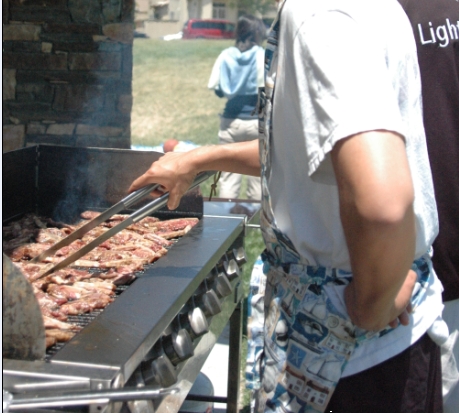
Hello, My name is Hwa and along with my wife Suzie and about 10 other faithful servants we make up the refreshments ministry. The primary purpose of this ministry is to glorify God by feeding our Church
family during various Church events (1 Corinthians 10:31). At our Church we love to eat and more specifically we love to eat a lot of meat and I have the pleasure of filling our bellies with yummy meat. We believe that God created everything that is on the earth and that all food is clean and suitable for consumption. With an exception that if eating or drinking causes a brother to sin we will abstain from it
(1 Corinthians 8:13).

Over the past 11 years the role of refreshments ministry has evolved from one person feeding about 30 people to now over 10 workers consistently feeding as many as 300 people. The Refreshments Ministry provides Sunday morning delights and refreshments for various other functions such as Fun in the Sun (FITS), Anniversary Services, Resurrection Sunday breakfast, Thanksgiving, Christmas, Mission bowl, and Members Meeting Dinners. Over the years I estimate we served about 11 thousand meals that include about…

  1. 700 lbs of Turkey
  2. 500 lbs of Ham
  3. 400 lbs of hot links
  4. 500 lbs of hot dogs
  5. 880 lbs of hamburgers
  6. 3,000 sandwiches
  7. 500 lbs of fried chicken
  8. 1,000 pizzas
  9. 15,000 bottles of water, sodas and juice boxes
  10. …and 1 lb veggie burger (back in 01′)

We can always use faithful servants that enjoy serving others through food. If you are a member please contact Suzie at suzie4jc@yahoo.com. How much food to prepare is always a challenge as we never really know how many people will show up to various Church functions. Portioning and menu planning can also be difficult as men will often consume more food then the ladies. Please pray that our team will serve others with a humble heart that seeks to glorify God.

Church BBQ Grill

Editor’s Note #2: March 2010

by Stephen Rodgers

The RSS button in the sidebar has been fixed. So if the only thing preventing you from enjoying RSS updates was my inept code, that obstacle has been removed.

If you prefer to enjoy the site simply by visiting it everyday, then nothing has changed for you.

Also, since we are once again benefiting from the DTR3 series at church, I wanted to bring your attention to some of the DTR-related content we have here on the Beacon:

Just letting you know.

Pro Rege

Book Review: Thoughts For Young Men

Book by J.C. Ryle

Book Review by Cesar Vigil-Ruiz

When you have thoughts reserved for young men that stem from personal experience, the basic qualification needed is that the person who has these thoughts is no longer young and is a man. It’s assumed these are thoughts that young men would benefit spending some time to consider. Well, from reading this short book, J.C. Ryle is more than qualified, and young men would be foolish not to heed this man’s advice.

If you don’t know anything about Bishop Ryle, you would think this book was written very recently, since many in our day are averse to spending time with young men, and would appreciate some kind of word that would jolt them into sober-mindedness. Surprisingly, for those unaware, Ryle died in 1900, and wrote this at a very late age (71 years old). How often would you come across an older man at that age who would gladly spend time with you and impart to you his wisdom that he’s gleaned over the years—especially a godly man? How many of us know men that age who are still following hard after Christ? It’s books like these that remind me that I am in need of learning—not to be proud of how much I know now, but grateful that I have a resource from which to observe this kind of wisdom. That’s what every book (including this one) has brought me to realize. I am not perfect in this life (nor will be), so I must grow in the knowledge of our Lord and Savior Christ, and, in His wisdom and sovereign will, has given various men (and women) in the faith to have wisdom to share with the body of Christ.

This book is broken up into four parts that J.C. Ryle believes is crucial for the life of a young man:

  1. The Reasons for Exhorting Young Men
  2. The Dangers of Young Men
  3. The General Counsels to Young Men
  4. Special Rules for Young Men

Titus 2:6 has formed the basis for why Ryle thought it necessary for him to write this book: “Young men likewise exhort to be sober minded.” Following the Apostle Paul’s advice, he plows through within each of these four sections, and speaks frankly, as well as compassionately, to the youth of his day (and ours) about the reality of life in a fallen world. Reading this book, I couldn’t help but be reminded of my need for older men to guide me in my walk with Christ, and to be slow to speak and quick to hear. Ryle knew the many temptations of a young man, since he was one. He remembers vividly the mistakes he made and saw that it as inherent in a young man to welcome many problems into their own life without giving an ear to one who has already gone before them.

If you have read anything written by Bishop Ryle, you know he asks very uncomfortable questions, not unnecessary ones. It’s pointed straight at the heart of every young man, who very much knows the answer to many of his questions, and yet could also be self-deceived into the answers they give. Easily, the entire book could be quoted, since there is much to learn from each sentence that he writes. Here are a few:

I tremble to observe how few young men are led by the Spirit—how few are in that narrow way which leads to life—how few are setting their affections upon things above—how few are taking up the cross and following Christ. (6)

Who in their families give them most pain and trouble?…Who are the class which requires the most incessant watching and looking after?…“The Young Men.” (7, italics his)

Two things are said to be very rare sights in the world—one is a young man humble, and the other is an old man content. (19)

Contempt of holy things is the high road to infidelity. Once let a man begin to make a jest and joke of any part of Christianity, and I am never surprised to hear that he has turned out a downright believer. (28)

[S]eek to become acquainted with our Lord Jesus Christ. This is, indeed, the principal thing in religion. This is the cornerstone of Christianity. Till you know this, my warnings and advice will be useless, and your endeavours, whatever they may be, will be in vain. (34)

And that is only half the book! This book is like listening to a father speak to his son about what is most important. However, in this case, it’s a worshipper of Christ who seeks to bring other people into true worship of the risen Savior, all for the love of the little ones (Mark 10:14). If you are a young man, read this book. If you are a man, read this book. If you have doubts as to how Christianity relates to your teenage life, read this book. If you are one who desires wisdom from above, read this book. Your life will never be the same, if you put into practice the appeals of this godly man.

Live Free or Die

by Elder Peter Lim

Some fun state mottos include “It Grows As It Goes” (New Mexico), “By and By” (Washington), “She Flies With Her Own Wings” (Oregon), and “Manly Deeds, Womanly Words” (Maryland). But perhaps the most memorable motto is New Hampshire’s “Live Free or Die”. This motto means serious business. They desire that the government keep their hands off as much as possible. They have no state tax. On one hand it speaks of a most noble desire to live with freedom above all else, even death. On the other hand it communicates a militant agenda, no doubt a reference to the values that led to the American Revolution. For Christians, our motto is similar to New Hampshire’s with some differences. It is based on Philippians 1:21 – For to me, to live is Christ and to die is gain. Paul had a difficult time deciding which option was better for him. (Phil. 1:22-24) To be able to live his life, he knew that he would fill it with profitable activities (see my last article “Minesweeper, Solitaire, Sudoku”) and so his life would revolve around Christ and His gospel. To die would mean an immediate trip home to be with Jesus forever. This was a win-win situation.

Too often, many Christians don’t think the way Paul thought. We would rather live our normal lives doing all the usual things that other normal non-Christians do. We may even try to Christianify different aspects of our life in order to justify our lifestyle. (yes, I made up that word) For example, we go watch a movie or play basketball and call it fellowship. We idolize celebrities and entertain ourselves with worldly thoughts, ideas and TV shows and separate these areas of our lives apart from our faith. Most of us work for a living in order to take care of our families. We strive to get promotions at work in order to earn a larger paycheck and to move up the corporate ladder. Then we buy nicer cars and live in big houses in order to make life convenient since we are working so hard to sustain this lifestyle. Note that none of these things are necessarily sinful all by themselves. However, the question is not whether something is sin or not. The question is, are we living for the sake of the gospel or not. A non-Christian family can do exactly the same thing as the example above. Then what is the difference between a Christian and a non-Christian? The difference must be Christ. Imagine someone going through High School with straight As, getting accepted to Harvard, starting a company that grows into the Fortune 500, retiring at age 40 with $500 million in assets, but is not living for Christ (whether this person claims to be a Christian or not), this is the epitome of a wasted life. If we don’t live for Christ, it’s not worth living. I am proposing that as Christians, we adopt our own motto based on Phil. 1:21: “Live For Christ or Die.”

Weekly Links (3/19/10)

by Stephen Rodgers

Sorry that the post is a few hours late this week…I blame the Single’s Retreat and my own laziness in not doing laundry in a more proactive fashion. But enough about that…on to the links!

Pro Rege

Photography Ministry

by Brian Song

You’re at church and you see a flash of light out of the corner of your eye followed by a series of clicking sounds. As you whip your head around, you barely catch a glimpse of what appears to be a person moving and carrying a rather large object in their hands…

The Photography Ministry at Lighthouse is comprised of men and women who share a common passion for taking pictures. Our ministry’s goal is to ensure that we capture the life of the church in pictures so that the church can relive them for many years to come. Generally, we meet 30 minutes before each event so that we can assign tasks for each team member. It may seem that we’re roaming around at random, but it often takes coordination and planning so that we don’t end up all shooting the same thing. Afterwards, everyone is responsible for uploading all the photos to our church’s photo website (http://www.lbcsd.smugmug.com). It usually takes our team anywhere from one to two weeks to filter through, process, and upload their shots online.

One of our other responsibilities is to maintain the member photos posted on the walls of the church. With all the changes taking place in the body (new members and growing families), we will continue to shoot members photos before, during, and after each member’s meeting. So if you’re a member and either need a photo taken or want an updated photo, please don’t hesitate to visit our “studio” during the next member’s meeting.

I’ve been so encouraged by our team’s willingness and faithfulness in serving the church through this ministry. One of most challenging aspects of this ministry is that whenever we’re serving, it oftentimes keeps us from fully enjoying the event with the rest of the body. As different (life stage) ministries hold events, team members from the other ministries have graciously taken time out of their busy schedules to volunteer to take photos so that the rest of the team can partake in the fellowship.

It is our great joy that God can use our passion for photography to capture his body carrying out the MVP of our church. All of us are more than excited to share our passion with others. So if you ever have want to know what camera to buy, to learn about different photography techniques, or even to join the photo ministry, please let us know!

Photo Team

Book Review: The Walk – The Life-Changing Journey of Two Friends

Book by Michael Card

Book Review by Cesar Vigil-Ruiz

Living a life that enables you to disciple someone else is one of great joy and hardship, of service and sacrifice, being mindful of the end goal, and filled with spontaneous moments of instruction. I think every time I read a book on discipleship, I see the many weaknesses I have and how I hope to be better. Reading The Walk has not been any different, since I can imagine myself placed in the many different situations the two men in this book were often in. Although I am definitely not an expert in leading another to growth in Christ, I try to find as much teaching as I can get.  Since I have such narrow vision, I need outside help to see what Christ wants me to see.

From the beginning, the book is about Michael Card, a Christian musician, and William Lane (not William Lane Craig), a biblical scholar, and their discipleship relationship. Interestingly enough, both Card and Lane are respected in their own field, which can appeal to either fans of Card’s music (count me one of them), or those appreciative of Lane’s writings (not yet). The book is written is in the same style as the famous Tuesdays with Morrie (by Mitch Albom), which emphasizes telling a story as a means of teaching. However, this book has a little of both: the teaching (or the walk, as Card puts it) and the truth of it lived out (or the story). Compared to other books on discipleship are popular now, this book is special in that Card recites some of the teachings that Lane had taught him, and he shows how his teacher’s life is in conformity to that truth. Most books will emphasize the teaching at the expense of showing how you apply it, and so this book does offer something new.

What caught me off guard while reading this book is the insight, wisdom, and love William Lane expressed to Card. Of course, being a biblical scholar, he had to have a working knowledge of the Word of God to be able to function as a seminary professor, but he shows those traits much more as a discipler. Their story begins when Michael is attending Western Kentucky University, with Lane as the interim pastor of his church.  Knowing him to be one who knows God, Michael asked if they could start meeting for a while, hoping to benefit from having Lane as his mentor. From their hikes, Michael grew to learn what Lane would later call the cycle of discipleship:

Bill saw three phases in Jesus’ pattern of discipleship. The first we find in Mark 3:13-15; it is the call to be with Jesus. The second phase, which is in Mark 6:7, 12-13, represents the commissioning of the disciples. The third is in Mark 6:30-31; here we see the disciples returning to Jesus, reporting to him all the things they had seen and heard. At this moment they heard the word from Jesus, “Come with me by yourselves to a quiet place and get some rest” (Mark 6:31). Bill used this pattern in his relationships with the students he mentored as well as in his own walk with the Lord. (46)

Those three phases form the structure for the rest of the book, and also serve as a metaphor for a Christian’s spiritual walk, as well as the structure for discipleship.  They became foundational for how Michael saw his life, as he relates towards the end of the book:

As I look at this cycle of discipleship and ministry, it’s interesting to apply it to the context of each day. I wake in the morning, and I’m with Jesus. I learn from Him. I read His Word. I spend time with Him. I realize my commission, and then I go out. I do His work and I speak His Word. Then, at the end of the day, I come back and report to Jesus everything I’ve done and everything I’ve said….You can apply the cycle over a day, over a matter of months, or over a lifetime. That was my experience with Bill, who first shared this concept with me. (125-126)

Many of the aphorisms in the book are reoccurring, such as: “When God gives a gift, He wraps it in a person” (22), “It is more important to say ‘I trust you’ than it is to say ‘I love you’” (43), and “Sonship/daughtership is established in the wilderness” (83). These sayings he had would end up pointing to the one he would keep in his heart most: “I want to show you how a Christian man dies” (109). William Lane found out in 1995 that he had cancer. His life now took a new turn towards returning to Christ, and he wanted to show Michael, both in teaching but now more than ever in modeling, how a man redeemed by his Savior is to die. Even in death, he wanted to die as one who honors Christ with his all.

This story has drawn many lessons I want to model in my own life, especially in regards to showing others how to understand God’s gift of Christ to us. Their unique friendship drew each other closer to Christ, and a exhibited the love Christian men have for one another: sacrificial love, love that will always sharpen, instruct, and nurture. The sad reality of it is, the world mocks this kind of love. The only reason they seem to do so is they don’t understand this kind of love because they’ve never experienced sacrificial love. This kind of friendship will always give hope, because it points back to Christ whom we are to be with, sent out by, and return to all throughout our lives.

Beware of Hypocrisy

by Pastor JR Cuevas

Woe to you, scribes and Pharisees, hypocrites!

I’m under no assumption that we will ever be a perfect church. Neither am I under any assumption that I will ever be a perfect person, nor should you. Apart from the person of Christ, no one ever walked the planet in perfect sinlessness, nor will anyone ever do so. One manifests the Spirit’s working in him not on whether he is free from sin, but on whether he fights sin. A Christian is nothing less than a soldier who wages war against the sinfulness that is dead in him yet still present in him. He who claims sinlessness calls God a liar, and the truth is not in him. Be aware of ever thinking that you have arrived, and guard yourself from becoming so insecure about your salvation every time you feel yourself struggling against your body of death.

Yet, as I followed the life of Christ and observed the way He treated sinners and handled different situations, oh so clear it has become that the Lord did not treat all sins equally. Every sin is worthy of condemnation – yet some sinners Christ still deemed as sons of God while some He deemed as sons of hell. True, we all struggle with sin. Yet, why is it that there are certain sinners in the Bible to whom Christ displayed His wrath? Every encounter that Christ had with a person – from his disciples to the Pharisees to the lepers to the adulterers – was an encounter with a sinner. And to many, He showed mercy. Yet, to some, He was harsh and condemning. True – God hates all sin. But is there a particular sin that, when unchecked, can almost surely lead him to being a vessel of wrath? All sin must be mortified, but is there one to which we must be particularly wary of and acidify all the more at its earliest roots? Christ seemed to think so, for He had a particularly intense aversion towards the sin of hypocrisy.

If you disagree, listen to the words of Christ Himself in Matthew 23, as He confronts the Pharisees for this very sin. In no where else do the Scriptures record such a wrathful condemnation of sinners as in this discourse of Christ’s condemnation of the Pharisees. To the tax collector Matthew, he simply told him to follow him. To the woman caught in adultery, He told her to sin no more. To the prideful and quick-to-speak peter, He rebuked him. But to Pharisees and the scribes, He called sons of hell. And, amidst all the things He mentioned in this long condemnation, the following was His main accusation: “Woe to you, scribes and Pharisees, hypocrites!” Seven times he repeated this, and thus you and I must heed. You who call yourself a follower of God, beware – BEWARE! – of hypocrisy. The sinner of a humble and contrite spirit He will not reject, but the sinner who breeds hypocrisy of the Scribes and the Pharisees He will condemn.

The word “hypocrite” in the Greek literally means “actor,” or “stage player.” One of the most appealing things about the “Behind the Scenes” or “Bloopers” section in the DVD of a movie is seeing the stark difference between the personality of the actor when in front of the camera and the one behind the scenes. The sin of hypocrisy, then, is this – a lack of wholeness in character that results in an inconsistency between who a person make himself out to be versus who he really is. It is the act of staging – pretending to be someone before people whom you are really not. Thus, spiritual hypocrisy is the staging of godliness that one does not have nor wish to have.

Listening to Christ’s several accusations against those hypocritical Pharisees and scribes, one learns much about how hypocrisy is manifested. Hypocrisy is the external staging of caring for people’s spiritual growth coupled with the internal reality of apathy and even animosity towards people. Hypocrisy is seen when one engages in so many external Christian activities such as praying and singing and teaching only for the sake of impressing people. Hypocrisy is being overly zealous about upholding certain aspects of Christian living such as tithing while neglecting the more important aspects such as justice, mercy, and faithfulness. Hypocrisy is pretending to be worshipful externally, when internally one writhes in self-worship, pride, and hatred for people. Hypocrisy is seen when one aligns himself with certain keynote theologians in their doctrines, yet fail to emulate them in their living. Hypocrisy is when one flatters people before their faces and slanders them behind. Hypocrisy is seen when one engages in spiritual activities and yet harbors unrepentant sin. Hypocrisy is when one assumes a different identity or personality before different people with the intention of pleasing them rather than serving them (a.k.a. acting). Hypocrisy is seen when one pretends to be without sin when inside he is swimming in it. The hypocrite is the one who claims to love God yet hates his brother. The underlying message that Christ had to these Pharisees: “Woe to you hypocrites, because you pretend to be godly externally when your hearts are filthy internally.”

Fighting for integrity, then, is a non-negotiable pursuit in Christian living. Everyone has the tendency to be hypocritical in one area or another, but not everyone is willing to fight it. One may have the sin of hypocrisy in him, but one becomes hypocritical when he refuses to fight the sin and allows it to master him. The man of integrity, then, is not so much the man who is absolutely free from hypocrisy but one who passionately fights against it and contritely repents when he exhibits it. Take heed, then, and flee from all hypocrisy. Pursue wholeness in character; pursue integrity in speech and action. Let the person you are before God be the same person you are before people – regardless of whom you are in contact with. Beware of hypocrisy, oh fellow saint, lest Christ say to you on the day of judgment, “You serpents, you brood of vipers, how shall you escape the sentence of hell?”

Weekly Links (3/12/10)

by Stephen Rodgers

Alright, there’s a lot of good stuff this week, so I’ll just jump right in. Besides, there’s really no chance of exhausting all of it, so we’ll save some for a rainy day.

Pro Rege