Author Archives: Stephen Rodgers

Weekly Links (2/26/10)

by Stephen Rodgers

Alright, insincere apologies in advance and all that, but this is going to be a rather lengthy version. Normally I aim for 8-10 links, but since you got a break last week, I’m allowing myself 15-20. Hey, you’ve got all weekend to read them right? Now you know what I do when I’m jetlagged and wide awake at 3am…

And if you’re thinking you’ll never make it through those, trust me, there’s a picture near the very end that you don’t want to miss.

  • First up, Wayne Grudem’s son Elliot has put together an FOF-esque study program using his father’s Systematic Theology. If you’re interested in checking it out, you can find it here. (Website, with PDF downloads)
  • Next, the folks over at Mars Hill had a very interesting series entitled “What Do You Live For?” They explore a number of problems not according to their symptoms, but rather according to their root cause as “worship disorders.” I thought it was quite interesting and thought-provoking, and you can check out parts one, two, and three. (Website)
  • Continuing our whirlwind tour of the offices and studies of several pastors, this week we get a sneak peek into the study of RC Sproul. (Video)
  • Andy Naselli offers his notes and the audio from a Q&A session where John MacArthur answered the question, “How would you approach a congregation trapped in years of legalistic tradition?” The answer may surprise you. (Website and MP3 download)
  • The more I read David Powlison, the more I really like the man. He recently offered a critique of the popular book “The Five Love Languages” which can be found here. (PDF) Additionally, there’s an introduction to the article as well as a response from Powlison to people who were not happy with his analysis. (Website)
  • Back in the spotlight again, Brian McLaren has a new book. The review have, well, not been kind. In particular, Kevin DeYoung offers a compassionate, but absolutely devastating review. The folks over at STR chime in as well. And the hits just keep on coming. (Website)
  • Jared Wilson has a message for Christians everywhere, but particularly for those in or pursuing ministry. He culminates in a rather violent but Biblically-sound image. (Website)
  • DA Carson has a short article on the benefits of expository preaching. It’s only two pages, and you get to see DA Carson with a mustache, so read it! (PDF)
  • The folks over at CREDENDAagenda have a great article on what it means to live out the Christian life in it’s totality, including your knowledge. If you struggle with the idea of being a Christian in ALL areas of your life, this article will challenge and inform you. (Website)
  • Over at Randy Alcorn’s blog, he has an account regarding Spurgeon’s worst sermon. Whether the account is apocryphal or true, the principle is valid. (Website)
  • Same blog, different article. And I think I’ve posted this before, but it’s just too good. In a debate with a liberal theologian, anti-theist Christopher Hitchens defines a Christian in astoundingly clear terms. (Website)
  • Pastor James Macdonald has an article with the intriguing title of “Holy Indifference: Learning to Say “I Don’t Care.” (Website)
  • And over at TeamPyro, Frank Turk has a fantastic article on the sovereignty of God. Or has he puts it, the biggest problem with Calvinism is Calvinists. Your going to need to read the article to find out exactly what that means. (Website)
  • Speaking of TeamPyro, I saw this and started drooling. I’m looking forward to this big time. (Website)
  • On a more hilarious note, I’ve wanted an excuse to post this for a long time. I still don’t have one, but I’m going to post it anyways. (Image)
  • Yes, there’s a good explanation. (Website)
  • And finally, on a more serious note, RC Sproul has two very short articles dealing with Calvin’s rules of prayer, which you can find here and here.

Pro Rege

Jonathan Edwards Resolution #60

by Pastor John Kim

To the LBC Family!

Jonathan Edwards Resolution #60
Resolved, whenever my feelings begin to appear in the least out of order, when I am conscious of the least uneasiness within, or the least irregularity without, I will then subject myself to the strictest examination.

Feelings are quite fickle. They come and go without warning and often times are the basis upon which we make decisions and lead to outcomes that are often regrettable. Why is this so? We have a very strong tendency to go with our emotional state and forego the idea of subjecting ourselves to “the strictest examination” because we don’t want to be bothered with truth principles. We want to satisfy our desires and cravings immediately. That’s why we are cautioned from making rash decisions that are void of careful prayer and consideration because we will start a course of action that can lead to consequences that are impossible to reverse.

Martyn Lloyd-Jones in his work “Spiritual Depression” warns against leading with the emotions as the basis for our decisions. Our emotions are not a reliable gauge to make wise decisions. We have to go back to the Word of God and have the truth of God by the Spirit of God transform our minds so that we could discern what the will of God is, that which is good, acceptable and perfect. We need to start with the mind so that truth would provide the foundation for the proper heart motives and desires to be cultivated which would then lead to true obedience out of love for God.

Psalm 19:7-11 describes the Word of God in ways that show how relevant it is to our lives. It is perfect, sure, right, pure, clean, true and righteous. It revives the soul, makes wise the simple, rejoices the heart, enlightens the eyes, and endures forever. It is to be desired more than fine gold and it is sweeter than honey. But verse 11 provides the key that helps us particularly when it comes to dealing with our feelings. God’s Word warns us and if we keep God’s Word, there is great reward. Why do we need to be warned? All too often our feelings lead us astray. We need a warning system that not only points out what is wrong with how we are living, but provides a corrective system that points us the right way.

So how are we to strictly examine ourselves when we see our feelings to be the least bit out of order or whether we feel uneasy inside or sense that something is wrong around us? We should examine ourselves according to God’s Word. Ask yourselves if you really have a biblical foundation for your decisions. Too many people are quick to be critical of other people’s decisions, but they fail to recognize the lack of a biblical basis for their own response. It is very ironic how those who are critical of others being unbiblical are unbiblical in the very way they go about responding to conflict and various situations. So we need to be careful in examining ourselves to see if we are consistent with what we say we believe.

We should go to the Word of God and have it be the final authority in teaching us, reproving us, correcting us, and training us so that we may be adequately equipped (2 Timothy 3:16-17), especially to deal with the turbulent and unpredictable emotions that come our way. We are not left to ourselves but we must prepare ourselves to fight the temptation of emotionalism that distracts us from being grounded in the truth. Feelings are not necessarily a bad thing in themselves, but if they lead the way, we will quickly find ourselves in places that will not be too helpful.

So consider again the resolutions of Jonathan Edwards and be resolved to deal with your life in light of God’s truth to His glory.

Until the whole world hears!
Pastor John

Announcements for this week:

  • Friday Night Bible studies continue: Youth (7pm in Room 107) and Single Life (7pm in the Sanctuary). College Life has their Winter Retreat this weekend – pray for them!
  • LBC Facilities Work Day. 2/27 from 9am-5pm. Come and help maintain the church facilities. We will be putting up some shelves, putting in some carpet and doing lots of painting. If you don’t know how to do some of these things, we are willing to teach you the necessary skills to help. Please talk to Thomas Fong for more details.
  • Pray for Pastor Jorge’s family as they have been delayed in Buenos Aires due to some documentation issues. We hope that they will be able to depart Saturday evening and arrive this Sunday.
  • Prepare your hearts for this Sunday as we go through John 9. Take time to read the whole chapter several times to become familiar with the text.
  • There will be no regular Sunday School classes for the adults this Sunday due to the College Retreat. In its place we will be having a Question/Answer session in the Sanctuary. You can submit your Bible/theological questions via e-mail ahead of time to Pastor John (pastorjohnkimlbc@gmail.com) or bring them Sunday.
  • The San Jose Church Plant Team will be meeting this Sunday from 3-6pm in Room 107.
  • Argentina Team Reunion Potluck! This Sunday evening at 6pm, we would like all those who were a part of the Argentina missions teams (both home and away) to come and welcome Pastor Jorge’s family. We will be having a dinner potluck so please bring either main dishes, side dishes, or desserts. Drinks will already be provided. Please e-mail Pastor John to confirm that you will be coming as well as what
    you plan to bring.
  • Shepherds Conference next week! If you are attending the Shepherds Conference next week, please make sure you communicate with Peter Lim to finalize travel and lodging plans.

Homeless Ministry

by Joyce Kang

This is the fifth year that LBC has been involved with the Pacific Beach homeless ministry as a branch of the Local Outreach Ministry. The involvement began in the formative years of the Local Outreach Ministry when member Kevin Tse introduced the PB ministry to LBC members.

Every Sunday, PB church members prepare a home-cooked meal for 100+ local homeless who come to enjoy a sit-down dinner. Although LBC involvement has evolved through the years, the consistency of the Pacific Beach members who have run the homeless ministry for over 15 years has been extremely encouraging and inspiring. Volunteers who go to help Sunday afternoons just need to show up as PB members will direct what help is needed with meal preparation and serving.

Through the years, devotions have been shared by Set Free ministries, as well as visiting pastors from other local churches who have come to volunteer.

For those who wish to help, a typical Sunday schedule might look as follows:

3:00pm – 3:30pm: Arrive at PB church
3:30pm – 4:45pm: Meal preparation
4:50pm – 5:00pm: Prayer
5:00pm – 6:00pm: Serving of meals

When LBC became involved with the ministry, a three-fold purpose was envisioned: To provide LBC members an opportunity to:

  1. get involved in the community as salt and light (Matt. 5:13)
  2. fellowship as they serve together in preparing and serving meals
  3. be obedient to Christ’s command to help the poor and needy (Deut. 15:11; Matt. 25:31-46)

Pacific Beach Presbyterian Church is located at 1675 Garnet Ave., Pacific Beach, and any interested LBC members are encouraged to make the initiative to go, whether as individuals or groups. If you have any questions, feel free to contact Joyce Kang or Grace Lee.

Living Theology #13 – Creation

by Garrett Glende

When it comes to doctrines, there aren’t many more crucial or life changing than the doctrine of creation. As we open the Bible and begin to read, we are challenged immediately as to how we will consider our lives in light of creation. Did God really create the world and all that exists in six days or is this some sort of poetic device? This is a serious question, as the manner in which we interpret Genesis 1 will actually influence our hermeneutics going forward in our study of Scripture. While this article is not intended to cover all the details of creation (i.e. age of the earth theories), it will provide a summary and defense of the Bible’s teaching (hopefully in much less words than it took me last week to explain the Trinity).

The first foundation of Biblical creation is that God created the world ex nihilo or out of nothing. When God made the universe, there was no pre-existent material that He used to form everything that we see today. John 1:3 says that “All things were made through him, and without him was not anything made that was made.” Even things that we cannot see have been created by God. Colossians 1:16 tells us that “by him all things were created, in heaven and on earth, visible and invisible…” There are many more verses attesting to this truth, but we should ponder the idea of something existing that has not been created by God, such as time. Wouldn’t this diminish the sovereignty of God? For if He has not created time, then how is He able to exercise any sort of authority over it? Would God then be at the mercy of anything that He has not created? Certainly, the Bible teaches otherwise and we can know that God has indeed created everything and uses it all to fulfill His good purposes.

Secondly, the Bible presents the creation of the world as an event that took place over the course of six literal twenty-four hour days. Many will try to explain this account away, citing modern science and logic, but we must remain faithful to the Scriptures. Nothing else in the book of Genesis allows us to interpret chapters one and two as anything but historical narrative. Genesis is as much history as Psalms is poetry and Daniel is prophecy. We must be faithful to a sound hermeneutic and take God’s word at face value. The reality is that God’s act of creation was a miracle and that it cannot be explained any other way. If we question Genesis 1, then what happens when we read about Jesus walking on water, feeding 5,000, or rising from the dead? Science cannot explain these things, so we must believe that God has interceded and done the miraculous. I should add that even though science does attempt to explain away miracles, the Christian must take the Bible as authoritative above all else. All that is genuinely true about science is because God has made it that way.

Lastly, it is important to understand that God has created all things for His own glory. Being the most wonderful and supreme being that He is, there is no greater purpose than to create a world in which His own beauty is mirrored. We see that nature and all that fills the earth has been intended to bring glory to God (Psalm 19:1, Isa. 43:7, Rev. 4:11). All we need to do is take a ten minute drive to the cliffs in La Jolla to realize what a wise and powerful God we have. This simple act of worship is exactly the response that God intends us to have in light of His creation.

As Christians living in view of the vastness of God’s works, we realize how small we really are. When we understand that we are just one of millions of things God has made, we should be truly humbled. He has made so many things that have little association to our lives. We should look around and sense that God has not created the world to center around us, but rather that He has made everything to point back to His own glory. A healthy humility and submission to the authority that God has as Creator are character qualities that are essential to living out the Christian life as it ought to be. May the words of Steven Curtis Chapman resound: “God is God and I am not.”

Minesweeper, Solitaire, Sudoku

by Elder Peter Lim

When Microsoft introduced Windows back in the 80s and early 90s, it took the PC world by storm. Instead of the command line, black (or amber) and white, character based display, people could now intuitively manipulate blocks of windowed information around. Apple fanboys cynically snickered that this was just a ripoff of the Macintosh Graphical User Interface, happily ignorant of the fact that their beloved Mac had copied other lesser known GUIs from Xerox Palo Alto Research Center and even the Atari computer. But I digress. With the introduction of MS Windows to the masses, millions of people were also introduced to games such as Minesweeper and Solitaire. Countless hours were devoted to uncovering bombs, arranging cards in sequential order, and other important endeavors. Then came games such as Tetris and Sudoku which were both more addictive and more time consuming. Of course computer games are not the only sources of time wasting. All throughout history, men have wasted time through various activities such as kicking a ball through a frame, hitting a ball with a stick, sitting on the dock of the bay watching the waves roll in, or drawing pictures. Even as I write this, my daughters have picked up their Nintendo DSs and are happily collecting virtual Pokemon and HPs.

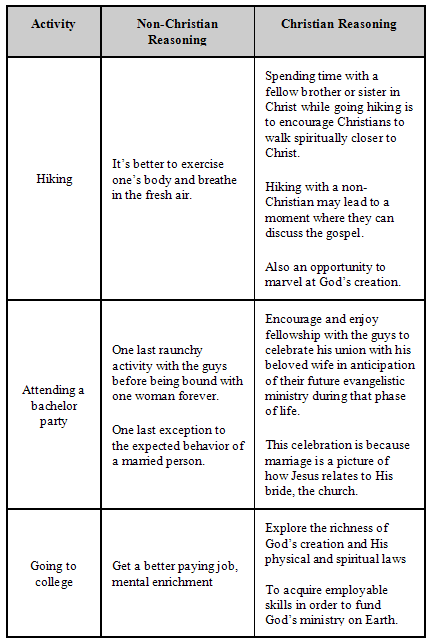
Such childish nonsense, one may think. Why don’t they get out of their time wasting activities and do something productive with their life such as [insert activity here]? Since evangelism is the only real profitable activity for a Christian (since it’s the one thing that can’t be done in heaven), he would fill in the blank with some activity that has something to do with evangelism in some way, shape or form. A non-Christian wouldn’t. This is true even if the activities that a Christian might do or a non-Christian might do are identical. Here are some examples:


Of course this is not to say that the chosen activities absolutely determine the condition of one’s heart. Only God knows the true condition. Our salvation is not earned because of what we do or don’t do. However, activities are a good indicator of what is contained in the heart. A tree is known by its fruit. (Matt. 12:33) Christians don’t always make good choices either. This is due to what I refer to as “man’s inefficiencies” of which I have too much of to my chagrin. We do need our recreational time too, don’t we? This need/want for recreational time (or entertainment) is the topic of a future article. Suffice it to say for now that Christians should be characterized by living for God’s glory, redeeming each opportunity for the sake of the gospel. We should endeavor to fill our lives with activities that are truly profitable that have eternal value. Let us not settle for living our lives in pursuit of worthless things such as the new high score in a video game.

Weekly Links (2/19/10)

by Stephen Rodgers

I’m in the Czech Republic this week, and between below-freezing temperatures, a rather minor bout with cold symptoms, fellowshipping with the church here, misbehaving internet, and some fabulous adventures, the Weekly Links is going to be rather puny this week. I just didn’t have the time, or the bandwidth (literally) to do more. I’ll try to make up for the lack of quantity by making it inversely proportional in terms of quality.

Enjoy.

That is all. Back next week.

Pro Rege

Jonathan Edwards Resolution #59

by Pastor John Kim

To the LBC Family!

Jonathan Edwards Resolution #59
Resolved, when I am most conscious of provocations to ill nature and anger, that I will strive most to feel and act good-naturedly; yea, at such times, to manifest good nature, though I think that in other respects it would be disadvantageous, and so as would be imprudent at other times.

*It has been over a year since I last wrote on Jonathan Edwards Resolutions so I am going to do my best to finish them off (there are 70 total) before I leave. So we are picking back up with Resolution #59.

There are times when people or circumstances might provoke us to anger or just a bad mood as people can often say things or do things that are not very encouraging. Sarcastic comments, biting remarks, blatant disregard, can rile up a person quickly. As parents we can let the disobedience of our children draw us into anger. In marriage, the expectations that have gone unmet can result in disappointment that degenerates into frustration and impatience. Friends sometimes say things that completely throw you for a loop and it ruins our day. But here is where we must always remember we have a choice – we are never forced into anger or forced into a bad mood. Yes, our emotions might not always be in line with how we know we should act, but we must again remember that it is acting upon what we know to be true that we must start with the truth engaging our mind and through the power of the Holy Spirit, provide the right motives and desires that would drive our obedience before God to truly be genuine and honoring before Him. That’s why Edwards even makes the comment that while we might feel it is disadvantageous to choose to act in a “good-naturedly” way, maybe seem even imprudent, he would rather strive to FEEL and ACT in such a way at those times to manifest good nature.

A good nature can only be truly good if God is at the center of it. God is good – His goodness must be the basis for any kind of goodness that I would manifest or it would not glorify God. That’s why we must be slow to anger (James 1:19-20) because the anger of man does not produce the righteousness of God.

We also need to remember that we can’t simply “psych” ourselves up to feel better. The only way to feel and act in a good way is to do so with the truth of God guiding us through the power of the Holy Spirit. We must submit our mind, heart, and will to the Spirit of God by being willed with the Spirit (Ephesians 5:18) so that our response to provocation would be an authentic Spirit-filled act that brings glory to God. It definitely is not a convenient or easy thing to do but one that would not only manifest the love of Christ (love is patient and kind – 1 Corinthians 13:4), but it would definitely defuse many a
volatile situation and bring peace.

So my prayer is this week that you would meditate on this thought and consider how you will respond differently when provoked to anger – see it as an opportunity to share the love of Christ!

Until the whole world hears!
Pastor John

Announcements for this week:

  1. Friday Night Bible studies continue: Youth (7pm in Room 107), College Life at UCSD (7pm), Single Life (7pm in the sanctuary – elder Peter Lim speaking this Friday!)
  2. Pray for Mike Hasegawa and Jennifer Shin as they get married this Saturday!
  3. Prepare your hearts for this Sunday as we go through John 8. Take time to read the whole chapter several times to become familiar with the text.
  4. Sunday School classes continue this Sunday during 2nd hour. If you have not chosen a class to attend, start this Sunday!
  5. Baptism Service this Sunday (Feb 21) at 6pm. Come out and witness the testimonies of those who will be confessing their faith in Christ. It is a wonderful time to celebrate what God has done to save His people.
  6. Be in prayer for Pastor Jorge, Norma, and Josue as they travel from Tucuman, Argentina to spend a few weeks with our church family starting February 26 (Friday). There will be more information given this Sunday as to how you can contribute to covering the costs for their visit as we are investing in their family to attend the Shepherds Conference as well as to minister to our church family. There will also be opportunities to host their family for meals so stay tuned!

GraceLife Ministry

by Pastor Patrick Cho

The GraceLife Ministry is specifically for married couples and singles parents at Lighthouse. The men meet on Tuesdays at 8:00pm and the women meet on Thursdays at 7:30pm. Both meetings are at the church in Room 107. Over the years it has been challenging coming up with a ministry format that could best work for GraceLife because most of our families are made up of couples with young children. As such, childcare is an issue at almost every church event. With the current format, while one parent is at the church fellowshipping with their peer group, their spouse can stay at home to spend time with the kids. In this way, our GraceLife members can enjoy needed fellowship and receive helpful accountability without the distraction of having to wonder how the kids are doing.

Each week, homework sheets are made available for GraceLife. They can be found either in the foyer on Sundays or online at the GraceLife website. The homework is a short questionnaire reviewing the past Sunday’s sermon. Each member is responsible for completing the homework before coming to GraceLife so they can participate in the large group discussion. This homework is helpful because most people probably never review the past Sunday’s message. Those who come out have commented that the homework helps them to keep God’s Word in mind throughout the week. The large group discussion times have been wonderful since the members contribute helpful insights and ask good questions.

After our large group time, the group breaks up into small groups. Our current small group leaders are Patrick Cho, Kent Hong, Min Kim, Peter Lim, and Steven Preslar for the men, and Christine Cho, Romi Hong, Angela Kim, Jane Kim, Carol Lim, Jinny Lim, and Lynn Preslar for the ladies. The small groups focus not only on providing accountability but also talking more about the practical outworking of the principles from the Sunday messages.

Although the homework given is for the GraceLife Ministry, we feel as though the exercise would really benefit anyone in the church. A couple questions that are asked are: 1) How did the sermon particularly focus on the character of God? What are some things that were taught about who God is? 2) What are some of your major reflections from the sermon? What points stood out to you, and why? and 3) What is at least one principle of application that particularly challenged you from the message? List three ways you can work to apply each of the principles to your life. Any believer who comes to church on Sunday should be thinking through these things on a weekly basis. GraceLife simply helps facilitate such meditation through the homework that is assigned.

It has been a tremendous joy serving in GraceLife and being able to spend time with the married men on a weekly basis. My wife also shares what a blessing it is to meet together with the ladies on Thursdays. It serves as a great way to be reminded to think God’s thoughts and consider God’s ways during midweek when the busyness of parenting, work, hobbies, etc. can drown out our spiritual priorities. As it is the primary place of providing accountability in the church for our married couples and parents, we highly encourage all to come out.

Living Theology #12 – The Trinity

by Garrett Glende

After spending two weeks covering a few attributes of God, we now take a closer look at the essence of who God is. Although it is a difficult (actually humanly impossible) doctrine to fully comprehend, we still must seek to understand the trinity because it lies at the core of the doctrine of God. Many Christians discount it as something only theologians and seminary professors need to worry about, but the reality is that we are all theologians. We all have our own views about who God is, but the matter is not what we think of God, but rather what God says about Himself. If the Bible does reveal God to be trinitarian (which it does), then we must believe what it says and have our lives transformed in light of it.

Grudem supplies us with a simple definition of the trinity to work with for our purposes. He writes, “God eternally exists as three persons, Father, Son, and Holy Spirit, and each person is fully God, and there is one God.” The definition is clear and to the point, each word deliberate and purposeful. It declares the eternality of the Godhead, the deity of all three persons, the equality of all three persons, and the oneness of God. I think it would be helpful to follow along with Grudem’s outline, as he gives three statements regarding the nature of the trinity and defends them all using Scripture.

1. God is Three Persons

This is to mean that there is distinction among the three members of the trinity. God the Father is not God the Son. God the Son is not the Holy Spirit, and so forth. We know this from passages where we see interaction between the different persons, such as the baptism of Jesus where we see the Father speaking from heaven, the Son being baptized, and the Spirit descending as a dove (Matthew 3:16-17). Moreover, when Jesus institutes the great commission in Matthew 28:18-20 He tells the disciples to baptize them “in the name of the Father, and of the Son, and of the Holy Spirit,” signaling the diversity and triune nature of the Godhead. If all three were the same person, then Jesus is really saying to baptize “in the name of God, and of God, and of God.” There are also instances where the Son prays to the Father (John 17) and is empowered by the Holy Spirit (Luke 4:1, Matt. 12:18). These things would not be if it were the case that God is one, yet simply expresses Himself differently at different times. God has always existed as three distinct persons, each one unique from the others.

The personhood of the Spirit has often been challenged, posing the idea that He is some sort of force or power. However, the Bible describes the Holy Spirit as a person, attributing to Him many personal qualities, such as the ability to be grieved (Eph. 4:30), the power to distribute gifts (1 Cor. 12:11), and the fact that He prays for all believers (Rom. 8:26-27).

2. Each Person is Fully God

It almost goes without saying the God the Father is God. The Bible doesn’t give any argument for His deity or existence. It simply opens with the statement, “In the beginning God…”

The foremost heresy among many cults is a denial of the deity of the Son. Here the Bible is also clear that Jesus Christ is God in human flesh, come down to save His people from their sin. John opens his gospel account testifying to the eternal deity of the Son: “In the beginning was the Word, and the Word was with God, and the Word was God” (John 1:1). Later on in verse 14 it is revealed to us that “the Word became flesh and dwelt among us, and we have seen his glory, glory as of the only Son from the Father, full of grace and truth.” John explains that the eternal logos has now exegeted the Father through His earthly ministry. The author of Hebrews extols Christ as “the radiance of the glory of God and the exact imprint of his nature, and he upholds the universe by the word of his power” (Heb. 1:3). The Son’s role in creation also attests to His divinity. Colossians 1:16 says that “…all things were created through him and for him.” We see that “all things were made through him, and without him was not any thing made that was made” (John 1:3). Coupling these verses with the creation account in Genesis 1, it becomes clear to us that Christ was the agent through which the world has come into being, bestowing upon Him the title of God.

As mentioned above, it is common for many to degrade the Holy Spirit to someone less than God, when Scripture is quite clear on the issue. The Holy Spirit is mentioned alongside the Father and the Son as Jesus gives the great commission in Matthew 28. We also see the deity of the Spirit in Acts 5 when Ananias and Sapphira “lie to the Holy Spirit and keep back for [themselves] part of the proceeds.” Peter tells them that they “have not lied to men but to God” (Acts 5:4). The Holy Spirit, along with the Father and the Son, was involved in creation, as He “was hovering over the face of the waters” (Gen. 1:2). There are many other passages to point to, but the purpose of this article is not to exhaust what the Bible offers, but rather to provide a summary.

3. There is One God

The last basic truth that Grudem deems essential to understanding the trinity in a true way is that there is only one God. Christianity is a monotheistic religion at its core. God is one, and splitting Him into three Gods creates idol worship, as our devotion would be divided. This is not a difficult claim to defend, as Scripture provides more than ample support for monotheism. We see Moses’ call to Israel in Deuteronomy 6: “Hear, O Israel: The Lord our God, the Lord is one” (Deut. 6:4). “I am the Lord, and there is no other, besides me there is no God” declares the Lord in Isaiah 45:5. The New Testament also advocates that “there is one God, and there is one mediator between God and men, the man Christ Jesus” (1 Tim. 2:5). We worship one God.

Application

A true Christian will not deny any of the above truths. People who profess faith in any other God but the triune God of the Bible are seriously mislead and will ultimately pay the penalty for their false worship. We, as Christians, know that there is one God in three persons, yet the challenge comes when we examine our lives and see if they match up with what we confess. As many of the singles at LBC have been learning recently on Friday nights, our view of the role of the Holy Spirit is often much lower than it should be. In essence, we say with our lips that He is God, but our lives reflect that we believe Him to be an impersonal force. The Holy Spirit is just as much God as the Father and the Son are God, and we must treat Him as such.

The nature of the trinity affects the way we live our everyday lives especially as it relates to our prayers. We should pray (and live) by the Spirit, through the Son, and to the Father. Each member of the Godhead plays a specific role. Our prayers are empowered and guided along by the Spirit’s work in our lives, while the Son is the One through whom we have access to the Father (Heb. 4:14-16, 1 Tim. 2:5), to whom we live to glorify in all things (1 Cor. 10:31). So when we pray we must depend on the Holy Spirit to fill us and help us to pray in the Father’s will, but we can only do so because of the work that Christ has done on our behalf. In this way, we can reflect a proper understanding of the trinity in our prayer life.

The doctrine of the trinity should also influence the way we interact with others. The essence of it all is that God is in a relationship with Himself, so to speak. Although our relationships are different (two people as opposed to three), we can still mirror God in some sense. The marriage between a man and a woman reflects the relationship of the Father and the Son in that there is authority and submission, yet mutual love and equality between persons. When the husband does not love his wife or the wife lovingly submit to her husband, then their marriage reflects a faulty understanding of the nature of God. This principle can be applied broadly to all in the sense that God desires us to be in communities with one another where we can glorify Him and make known His character to others.

However confusing this doctrine might seem to us, we must submit to the teaching of Scripture, not our own understanding. If anything, the fact that we cannot fully grasp the mystery of the trinity should make us bow down in worship to God, for He truly is high above us. We must seek to live lives that honor God and mirror the fullness of truth revealed to us, specifically as it relates to the members of the Godhead. May our hearts and minds eagerly yearn glorify the triune God of Scripture, as He is most deserving of all our praise.

How to Go to Church

by Pastor John Kim

A few weeks ago, we went over “How to Go to Church” and as we discussed the reality that every church is imperfect and needs to improve, one of the most significant things that we can do is to specifically and deliberately prepare to hear the sermon. John Piper’s article on “10 Practical Preparations for Hearing the Word of God on Sunday Morning” give a very helpful strategy that I think would transform people’s perspectives when it comes to the attitude you have as you hear the sermon begin. The impact of a sermon is really going to depend on how the individual prepared their heart attitude. I think this is something to so crucial yet so missing in most churches that it shouldn’t be a surprise that there is at most an apathetic response to the sermon all the way to scathing criticism.

But it goes beyond just preparing to listen. There must be a lifting up of prayer for the preacher as he prepares for the sermon. How many times can you say that you have prayed for your pastor as you opened your Bible Sunday morning to hear the sermon? Did you pray for his preparation during the week? Did you pray for the delivery of the message? Did you pray that other people might be impacted as well? Michael Fabarez has written a short booklet where the practice of praying for your pastor’s preparation and delivery of the sermon should be something that every church puts into practice as a regular ministry.

I would highly recommend for you go through the following outlines and consider how you can practically prepare your heart and your mind to receive the sermon. I trust that before you lift up a finger of criticism of the sermon that you will have first lifted up your hands in prayer for your pastor to be led by the Holy Spirit in preparation as well as in delivery so that people’s lives would be drawn to the cross of Jesus Christ.

Remember, the Sunday sermon is not just a nice self-help, inspirational time where people’s emotions are to be moved and left to that end. The Sunday sermon is meant to be a genuine interface with the living God as the Word of God is presented through the power of the Holy Spirit in all its authoritative sufficiency as the sword of the Spirit so that our very being would be pierced to the division of soul and of spirit, of joints and of marrow, and discerning the thoughts and intentions of the heart (Hebrews 4:12).

Don’t just think about this! Do it! And as you apply these thoughts, trust that God will bring great blessing both to you and to your church family.

10 Practical Preparations for
Hearing the Word of God on Sunday Morning
by John Piper

Luke 8:18
18 Take care then how you hear, for to the one who has, more will be given, and from the one who has not, even what he thinks that he has will be taken away.

  1. Pray that God would give you a good and honest heart (Ezekiel 26:36, Jeremiah 24:7)
  2. Meditate on the Word of God (Psalm 34:8, Psalm 1:1-3)
  3. Purify your mind by turning away from worldly entertainment (James 1:21, Philippians 4:8, Colossians 3:1-2)
  4. Trust in the truth you already have (Jeremiah 17:7-8, Proverbs 3:5-6, Psalm 119:41-42)
  5. Rest long enough Saturday night to be alert and hopeful Sunday morning (1 Corinthians 6:12)
  6. Forebear one another Sunday morning without grumbling and criticism (Psalm 106:25, 1 Corinthians 10:1-12, Philippians 2:14, James 1:19)
  7. Be meek and teachable when you come (James 1:21)
  8. Be still as you enter the room and focus your mind’s attention and heart’s affection on God (Psalm 46:10)
  9. Think earnestly about what is sung and prayed and preached (1 Corinthians 14:20, 2 Timothy 2:7)
  10. Desire the truth of God’s Word more than you desire riches or food (1 Peter 2:2, Psalm 19:10-11)

Praying for the Pastor and the Sermon
by Michael Fabarez

Colossians 4:3
3 At the same time, pray also for us, that God may open to us a door for the word, to declare the mystery of Christ, on account of which I am in prison—

A. Pray for the Crafting of the Sermon

  1. Pray that the message your pastor is preparing to preach would be an evident part of his own life.
  2. Pray for the protection of your pastor’s sermon preparation time.
  3. Pray that your pastor will be given grace and illumination to rightly divide God’s word.
  4. Pray that the words your pastor chooses to frame the outline would be effective and powerful tools for the Holy Spirit to employ.
  5. Pray that your pastor would have insight into the needs of the congregation as he prepares the sermon.

B. Pray for the Delivery of the Sermon

  1. Pray that people will attend the preaching event.
  2. Pray that the congregation would arrive in the right frame of mind.
  3. Pray that God would guard against preaching distractions.
  4. Pray for clarity and power in the pastor’s vocabulary.
  5. Pray that God will give understanding to all who hear this week’s sermon.
  6. Ask God for the most effective and fruitful sermon your pastor has ever preached.

C. Pray for the Response to the Sermon

  1. Pray that all, including yourself, will put the sermon into practice.
  2. Pray that the sermon will not be compartmentalized.
  3. Pray that the application of the sermon would be contagious.
  4. Pray that the sermon itself will be repeatedly delivered