
Author Archives: Stephen Rodgers

BOB – Daniel

by Stephen Rodgers

DANIEL IN 10 WORDS OR LESS

“Faithful to God in a challenging setting, Daniel is blessed.”

TITLE

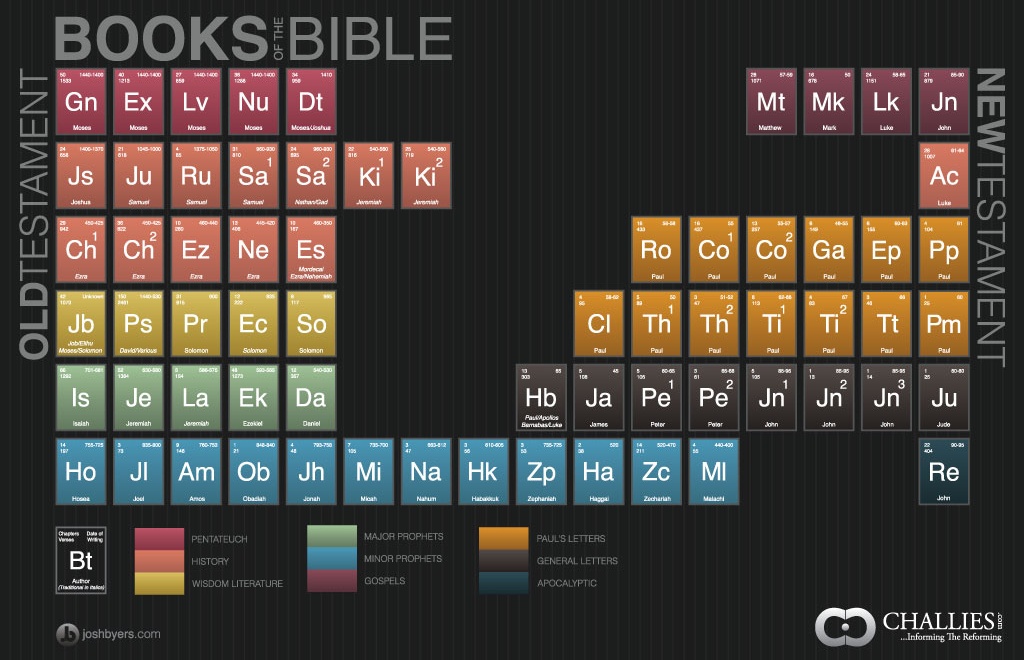
Like almost all the other prophetic books, the book of Daniel takes its name from the prophet responsible for its content. And since Daniel is a particularly significant book in the context of the OT, let’s get this started with a more-expanded-than-usual quote from the MSB:

According to Hebrew custom, the title is drawn from the prophet who throughout the book received revelations from God. Daniel bridges the entire 70 years of the Babylonian captivity (ca. 605–536 B.C.; cf. Dan. 1:1 and 9:1–3). Nine of the 12 chapters relate revelation through dreams/visions. Daniel was God’s mouthpiece to the Gentile and Jewish world, declaring God’s current and future plans. What Revelation is to the NT prophetically and apocalyptically, Daniel is to the OT.

AUTHOR & AUDIENCE

Per the MSB:

Several verses indicate that the writer is Daniel (Dan. 8:15,27; 9:2; 10:2,7; 12:4,5), whose name means “God is my Judge.” He wrote in the autobiographical first person from Dan. 7:2 on, and is to be distinguished from the other 3 Daniel’s of the OT (cf. 1 Chr. 3:1; Ezra 8:2; Neh. 10:6). As a teenager, possibly about 15 years old, Daniel was kidnaped from his noble family in Judah and deported to Babylon to be brainwashed into Babylonian culture for the task of assisting in dealing with the imported Jews. There he spent the remainder of a long life (85 years or more). He made the most of the exile, successfully exalting God by his character and service. He quickly rose to the role of statesman by official royal appointment and served as a confidante of kings as well as a prophet in two world empires, i.e., the Babylonian (Dan. 2:48) and the Medo-Persian (Dan. 6:1,2). Christ confirmed Daniel as the author of this book (cf. Matt. 24:15).

Per Constable:

There is little doubt among conservative scholars that Daniel himself wrote this book under the Holy Spirit’s guidance. Probably he did so late in his life, which could have been about 530 B.C. or a few years later. Several Persian-derived governmental terms appear in the book. The presence of these words suggests that the book received its final polishing after Persian had become the official language of government. This would have been late in Daniel’s life. What makes Daniel’s authorship quite clear is both internal and external evidence. (see OBJECTIONS)

Assuming a traditional date of composition (approximately 530 BC), Daniel would have been writing for the benefit of other Jewish exiles in Babylon.

DATE

Per the MSB:

Daniel lived beyond the time described in Dan. 10:1 (ca. 536 B.C.). It seems most probable that he wrote the book shortly after this date but before ca. 530 B.C. Daniel 2:4b–7:28, which prophetically describes the course of Gentile world history, was originally and appropriately written in Aramaic, the contemporary language of international business.

Ezekiel, Habakkuk, Jeremiah, and Zephaniah were Daniel’s prophetic contemporaries. (As discussed below, Ezekiel actually references Daniel twice).

BACKGROUND & SETTING

Roughly speaking, you can think of Jeremiah as the prequel to both Ezekiel and Daniel, with the latter two being simultaneous and roughly concurrent sequels which continue the story from different points of view, which in turn set up the events in Ezra and Nehemiah.

So let’s do a quick review just to get our bearings:

  • We’re way past the unified kingdom of Saul, David, and Solomon; that’s in the rear-view mirror.
  • We’re also past the divided kingdom of Israel and Judah. The northern kingdom already got conquered by the Assyrians and carried off into exile.
  • Since that happened, the southern kingdom is sort of hanging on by their fingernails. The Assyrians aren’t really the baddest gang on the block anymore; at this point the real heavy hitters are the Egyptians (to the south and west) and the Babylonians (to the north and east). So the southern kingdom is really in the incredibly unenviable position of getting caught in the middle.
  • The southern kingdom fights a delaying action, but eventually Jerusalem gets overrun by the Babylonians (see: Jeremiah) for the first time (yes, there was a second time, and it wasn’t pretty), and carried off into exile. Some of those exiles wind up in one place (see: Ezekiel), and some wind up in another place (which brings us to Daniel), which just happens to be the very heart of the Babylonian empire.
  • We have not yet gotten to the part where the exiles come back to Jerusalem (see: Ezra and Nehemiah); that will come later.

Got it?

That’s where Daniel starts: a teenage captive, deep behind enemy lines, in a foreign land. It doesn’t look good, but as we’ll see, God has a plan.

HISTORICAL & THEOLOGICAL THEMES

There are several themes which run through the book of Daniel.

  • God’s Sovereignty: Perhaps the most significant theme in Daniel is God’s absolute authority over world history (Dan. 2:47; 3:17-18; 4:28-37; 5:18-31), which specifically includes kingdoms and governments (Dan. 5:21)
  • Faithfulness to God: God rewards those who are devoted to Him (Dan 1:8 with 1:15-20; 2:17-18 with 2:19; 2:27-28 with 2:48-49; 3:12, 16-18 with 3:26-30; 5:16-18 with 5:29; 6:7-12 with 6:19-24). What is especially relevant for us today is that we see it is possible for God’s people to survive (and even thrive) in the midst of real oppression.
  • Prophecies of Future Events: Daniel’s four visions contain predictions of both the near and far future, as well as the return of the triumphant Christ (Dan. 7:11, 26-27; 8:25; 9:27; 11:45; 12:13).

INTERPRETIVE CHALLENGES

This is almost too big to tackle within the context of this article, so I’m just going to give a quick summary: eschatology.

As mentioned in the TITLE section, it’s not unreasonable to think as Daniel being the OT equivalent to the NT book of Revelation. Both are prophetic, both are apocalyptic (some scholars consider them to be the only two unqualified examples of the apocalyptic genre in the Bible: e.g. Robert D. Culver, “Daniel,” in The Wycliffe Bible Commentary and Edward J. Young, The Prophecy of Daniel: A Commentary).

As a result, not only is the content subject to the various interpretations and understandings that often occur when dealing with prophetic imagery (such as the precise meaning and understanding of various numbers (including the infamous “77s”), the Son of Man, the juxtaposition (or not) of Antiochus/Antichrist, etc.), but it is also going to inform and be informed by eschatological positions as well. Since there are a range of those expressed in historically orthodox Christianity, you can expect a range of understandings in regard to the eschatological features of Daniel as well.

LITERARY FEATURES

Per the ESVSB:

The book of Daniel is unique in the Bible in falling decisively into two distinct genres in its two halves. The first six chapters are hero stories comprised of six self-contained ordeals. The last six chapters are a series of visions that employ highly symbolic images to portray vast stretches of political and spiritual history. The visions that deal with the end times are apocalyptic visions. The techniques of symbolic reality figure prominently in all of the dreams and visions, including those in the first six chapters; in symbolic reality, the world that is entered consists largely of great symbols instead of literal characters and places.

OBJECTIONS

Objections to Daniel began in the third century with Porphyry (a neo-Platonist who disputed traditional authorship and dating), but pretty much disappeared after he was subsequently refuted by Jerome. Then the 18th century brought us Germans and rationalism, and Porphyry’s theory was re-raised by J. D. Michaelis. Since then there have been a number of criticisms levied against the book, which I will attempt to summarize and explain here:

  • Categorization. Much has been of the fact that Daniel is not included in the Nevi’im (Prophets), but rather is found in the Kethuvim (Writings) in the TNK (you do remember the OT Canon right?). This is easily explained by the fact that Daniel occupied a unique yes-and-no role when it came to prophecy. In one sense, he was a prophet: after all, he prophesied. In another sense, he was not a prophet: he did not minister exclusively to or among Israel, and his function was primarily that of an administrator in a foreign court.
  • Authorship. Interacting with the various challenges to traditional authorship would require a separate paper, but suffice to say that Daniel is attributed as the author both in the book itself (Dan. 7:1; 12:4), by his contemporaries (Eze. 14:14, 20; 28:3), and by Christ and NT authors (Matt. 24:15 and Mark 13:14; Matt. 26:64, Mark 14:62 and Luke 22:69; Heb. 11:33-34).
  • Dating. In addition to contemporaneous attestation mentioned above, a number of the Qumran scrolls have been dated within 40 years of the so-called “late date,” which presents significant problems for critics of traditional authorship/dating. In addition, if one accepts the premise that the LXX was translated more or less collectively in the third century BC, then the late date becomes impossible.
  • Archaeological and Linguistic Evidence. A number of alleged historical inconsistancies or issues (such as the existence of Belshazzar) have recently been re-evaluated in light of archaeological discoveries. Furthermore, his Hebrew and Aramaic are consistent with both biblical and extra-biblical documents from the fifth and sixth centuries, BC (not the second century BC that the late date postulates).

NOTABLE QUOTABLES

  • Daniel 3:17
  • Daniel 6:22
  • Daniel 9:18

DID YOU KNOW?

  • The book of Daniel was originally written in two languages: Hebrew (introduction, most prophecies, chapter 1, and chapters 8-12) and Aramaic (chapters 2-7).

Other Works Referenced

  • Apologetics Study Bible, Daniel”
  • Archaeological Study Bible, “Introduction to Daniel”
  • ESV Study Bible, “Introduction to Daniel”
  • MacArthur Study Bible“Daniel”
  • NET BibleDaniel
  • NIV Study Bible, Daniel
  • Reformation Study Bible, “Daniel”
  • The Baker Illustrated Bible Handbook, “Daniel”
  • Know Your Bible
  • Dever, The Message of the Old Testament
  • Driscoll, A Book You’ll Actually Read On the Old Testament
  • Knight, The Layman’s Bible Handbook

FOF #3 – God: His Character and Attributes

“Yours, O Lord, is the greatness and the power and the glory and the victory and the majesty, indeed everything that is in the heavens and the earth; Yours is the dominion, O Lord, and You exalt Yourself as head over all.” (1 Chronicles 29:11)

by Pastor Patrick Cho

Every once in a while, someone will ask me how I read through the Bible. Most of the time, I just enjoy reading the Bible to understand the general overall story as it unfolds. But sometimes I read the Bible looking to study a particular theme, and one of my favorite themes to focus on is the character of God. It is always impactful and eye-opening to examine what the Scriptures say about God. And it is humbling to consider that God would condescend to us and reveal Himself in the pages of Scripture. Though we cannot know Him comprehensively since He is infinite and we are finite, we can still know Him truly because whatever the Bible says about God is true. Chapter 3 of Fundamentals of the Faith covers the topic of God.

If you walk around and ask random people if they believe in God, many might tell you they do. I had a chance to do this while attending UCSD as a student. All sorts of people would tell me that they believed in God, some higher being, or a cosmic force. Each person had their own opinions and ideas about what God was like. For some, God was a good being who was the source of everything good. For others, God was a cosmic energy that gave life and sustained all that is. Some people shared that they didn’t know or that we couldn’t know what God is like. Others had come to very strong conclusions about Him.

Thankfully, we are not left to our own speculation to guess at what God is like. He is not simply defined by what we want Him to be. He has clearly revealed Himself in the pages of Scripture. When God met with Moses, He gave a description of Himself by proclaiming, “The LORD, the LORD, a God merciful and gracious, slow to anger, and abounding in steadfast love and faithfulness, keeping steadfast love for thousands, forgiving iniquity and transgression and sin, but who will by no means clear the guilty, visiting the iniquity of the fathers on the children and the children’s children, to the third and the fourth generation” (Exod. 34:6-7). The pages of God’s Word help us to understand who God is, what He is like, and how He acts.

There are many various attributes of God that are revealed in Scripture. God is found to be eternal, all-powerful, all-knowing, never changing, righteous, merciful, good, and gracious. The Bible tells us that God is one (Deut. 6:4), He is love (1 John 4:16), and He is light (1 John 1:5). God is spirit (John 4:24) and is not a man (Num. 23:19; except in the Person of Jesus, which will be the focus of the next chapter!). God is all these things and more, and it is incredibly exciting to be able to know Him and to study what He is like.

This is an exercise you might want to try as you read your Bible. Keep a journal and pen handy (or a laptop open) and jot down observations you make about God as you read. Write notes on what passages tell you what God is like. Also keep note of the passages that tell you how God acts or what He requires of His people. These sorts of things can help us understand more clearly who He is. As you read His Word, hopefully your view of God will increase so that you will come to love Him more and live for Him more faithfully.

…the Mighty God of Jacob

by Charles Haddon Spurgeon

From Genesis 49:24

That strength which God gives to His Josephs is real strength; it is not a boasted valour, a fiction, a thing of which men talk, but which ends in smoke; it is true-divine strength. Why does Joseph stand against temptation? Because God gives him aid. There is nought that we can do without the power of God. All true strength comes from ‘the mighty God of Jacob.’

Notice in what a blessedly familiar way God gives this strength to Joseph-‘The arms of his hands were made strong by the hands of the mighty God of Jacob.’ Thus God is represented as putting His hands on Joseph’s hands, placing His arms on Joseph’s arms. Like as a father teaches his children, so the Lord teaches them that fear Him. He puts His arms upon them. Marvellous condescension! God Almighty, Eternal, Omnipotent, stoops from His throne and lays His hand upon the child’s hand, stretching His arm upon the arm of Joseph, that he may be made strong! This strength was also covenant strength, for it is ascribed to ‘the mighty God of Jacob.’ Now, wherever you read of the God of Jacob in the Bible, you should remember the covenant with Jacob.

Christians love to think of God’s covenant. All the power, all the grace, all the blessings, all the mercies, all the comforts, all the things we have, flow to us from the well-head, through the covenant. If there were no covenant, then we should fail indeed; for all grace proceeds from it, as light and heat from the sun. No angels ascend or descend, save upon that ladder which Jacob saw, at the top of which stood a covenant God. Christian, it may be that the archers have sorely grieved you, and shot at you, and wounded you, but still your bow abides in strength; be sure, then, to ascribe all the glory to Jacob’s God.

2.22a

The Proper Place of Fellowship

by Henry Shieh

The sweetness and love of fellowship is something that I am thankful for the most, whenever I’m with believers. People are constantly encouraged, comforted, loved during times of fellowship. But should fellowship be our top priority? It is biblical, but is it the only thing that sustains our faith? Sometimes I act like fellowship is the necessary and sufficient feature of my faith and if I don’t have it, I’ll be lonely and nothing else will be important. I tend to think that I’m alone, excluded, out of the loop, unloved etc…

God has blessed me with the opportunity to live with believers and non-believers on campus, but none of whom are part of Lighthouse. Many Lighthouse collegians live on another part of campus which is “further”(I use quotes because it’s actually not that far) and I don’t get the opportunity to spend as much time as I would like with them. Sometimes I play the victim, have sinful/judgmental thoughts, have a “woe is me” mentality, and say “my life is so difficult because I’m so far away from others.” I’m constantly complaining to God that I am alone.

There’s a giant problem with that complaint; who am I really putting my trust in? Am I truly with my whole heart putting my trust in God? Or man?

Don’t get me wrong, having fellowship with one another is important, but relying on fellowship is not the same as trusting on God. One could say, “Of course I’m trusting in God, but I need fellowship!”

Oh really?

We’re called to put our faith in God and not man. I’m not saying you cannot trust in man, I am saying that you must trust God with everything you’ve got because He is the greatest source of comfort, and He can bear all of the burdens. God is the rock that we must build our house on. He can withstand everything. If we trust man, we are like the foolish man who builds his house upon the sand. Just one storm and the foundation is a goner.

This sense of loneliness is just the result of pitying one’s self and is not true! Feeling lonely and that no one loves you is just a result of a selfish heart. Why must everyone in the whole world flock to my needs? I hope this encourages those who feel lonely because the fact of the matter is, you aren’t. God is sufficient and He is all that you need. What you need is different from what you want.

Whenever you feel that you’re alone and that there is no love in your life, I challenge you to ask yourself this: who are you putting your trust in? Is it in God who is faithful and unchanging, and who  has/is/always will love you?

Or is it man?

BOB – Ezekiel

by Stephen Rodgers

EZEKIEL IN 10 WORDS OR LESS

“Though Israel is in exile, the nation will be restored.”

TITLE

Like most (but not all…hi there Lamentations!) of the prophetic books, Ezekiel takes its name from the prophet who was responsible for the prophetic utterances contained within it. As a result, the TITLE and AUTHOR sections tend to get a bit muddled, but this would be a good time to mention that Ezekiel is mentioned only in the book that bears his name, although he does refer to some of his contemporary prophets either explicitly (Daniel) or implicitly (Jeremiah).

Per Constable:

The title of this book comes from its writer, Ezekiel, the son of Buzi (Eze. 1:3). “Ezekiel” means “God strengthens (or hardens)” or “God will strengthen (harden)” or “May God strengthen (harden).” The name “Hezekiah” is similar, meaning “May Yahweh strengthen.”

AUTHOR & AUDIENCE

For someone whose name appears only in two verses, there is surprisingly little dispute as to the identity and authorship of Ezekiel. Although no other Biblical writer refers to him, the book that bears his name is more autobiographical than the other major prophets such as Isaiah or Jeremiah. On top of that, Ezekiel wrote the vast majority of the book in chronological order, with great attention to the dates that corresponded to the events he wrote about.

Per the MSB:

Prophecies in chaps. 1–28 are in chronological order. In Eze. 29:1, the prophet regresses to a year earlier than in Eze. 26:1. But from Eze. 30:1 on (cf. Eze. 31:1; 32:1,17), he is close to being strictly chronological.

Per Constable:

Ezekiel was a Judean priest of Yahweh as well as His prophet, as were Jeremiah (Jer. 1:1), Zechariah (Zech. 1:1), and John the Baptist (Luke 1:5). Ezekiel, Jeremiah, and Zechariah were the only writing prophets who were also priests, and they all ministered during or after the Babylonian exile. Like Jeremiah, there is no evidence that Ezekiel ever served as a priest in the Jerusalem temple. Ezekiel’s priestly background may account in part for the interest in priestly things that his book reflects: the actions of the priests in Jerusalem, the Jerusalem temple, the glory of the Lord, and the future temple yet to be built. It probably also explains Ezekiel’s familiarity with things connected with priestly ministry, such as cherubim. His wife died during the course of his ministry (Eze. 24:2, 15-18), but there is no mention in the book that they had children. There are no records of Ezekiel’s life outside this book, so we have no information about when, where, or how he died.

Essentially, Ezekiel is a man who’s life didn’t go according to his plan. He prepared to become a priest, only to see that become an impossibility with the Babylonian invasion and the destruction of the temple (not to mention the fact that he was carried off into exile as part of the initial invasion). At age 30 (the typical age for him to begin his priestly service), he instead received a vision from the LORD and became a prophet. So even though his life didn’t go according to his plan, one can clearly see the hand of God in his life.

DATE

It is helpful to remember at the outset that Numbers 4 records that the age of service for a priest of the LORD was from 30 to 50.  This corresponds nearly perfectly to the period of Ezekiel’s life when he wrote the book that bears his name.

Per Constable:

The book records the date of the beginning of Ezekiel’s ministry as 593 B.C. (Eze. 1:2-3). The last dated prophecy came to the prophet in 571 B.C. (Eze. 29:17). He began ministering when he was 30 years old (Eze. 1:1), and he gave his last prophecy when he was about 52. Ezekiel’s whole ministry transpired during the reign of King Nebuchadnezzar of Babylon (605-562 B.C.).

BACKGROUND & SETTING

Ezekiel is set against the backdrop of the Babylonian invasions…yes, plural. Remember that the initial fall of Jerusalem took place in 597 BC, and the Babylonians carried off most of the aristocracy and leadership into exile (including Ezekiel). However, the remaining leaders in Jerusalem committed a double-whammy of errors: they refused to turn from their idolatrous ways and heed the call of the LORD, and they refused to heed Jeremiah’s advice and rebelled against the Babylonians, prompting a second invasion that resulted in the destruction of both Jerusalem and the temple.

HISTORICAL & THEOLOGICAL THEMES

There are several themes that run through the book of Ezekiel:

  • Judgment. The idea of the covenant lawsuit is in full effect in Ezekiel, and he prophesied that God would judge both His people (Eze. 1:1-24:27) and foreign nations (25:1-32:32) for their sinful behavior.
  • God’s Sovereignty. I previously pointed out that Ezekiel’s life itself was an example of God’s sovereignty, but it’s also a major theme of the book. One valuable lesson that we learn from Ezekiel is that the judgment of God is often inseparable from the self-revelation of God (which actually is a recurring motif in Framean ethics, but that’s an article for another day).
  • Future Hope. Ezekiel is quite clear that there is hope for God’s people after judgment (Eze. 33:1-39:29).

INTERPRETIVE CHALLENGES

Because Ezekiel is rife with eschatological imagery, one’s understanding of the book will necessarily depend somewhat on one’s eschatalogical perspective. However, while some of the imagery seemingly defies description, the book as a unit is not difficult to apprehend.

LITERARY FEATURES

Per the ESVSB:

Several observations are in order. First, much of the book consists of visionary writing, which transports readers to a world of the imagination where the rules of reality are obviously suspended in favor of highly unusual visions. To understand and relish the book of Ezekiel, readers often need to abandon expectations of realism. Second, Ezekiel employs a technique known as symbolic reality, which occurs when a writer consistently transports the reader to a world of visionary experience where the most important ingredients are symbols—symbols like a vine, a boiling pot, or a valley full of dry bones. Third, prophecy is itself a genre, made up of oracles (pronouncements from God through the agency of a prophet) that fall into two main categories—oracles of judgment and oracles of blessing. Oracles of judgment are ordinarily examples of satire, and in the prophetic satire of Ezekiel there are three motifs: (1) description of evil, (2) denunciation of this evil, and (3) warnings and predictions that God will judge the evil. Prophecy often merges with apocalyptic writing about epic, end-time struggles. These sections often portray events at the end of history. Finally, readers should not overlook the obvious—the prophet Ezekiel expresses himself in the form of poetry.

OBJECTIONS

As previously mentioned, Ezekiel is both highly autobiographical and meticulously noted from a chronological perspective; as a result, there are no significant objections that I am aware of.

NOTABLE QUOTABLES

  • Ezekiel 18:32
  • Ezekiel 36:26

DID YOU KNOW?

  • The inner courtyard of Ezekiel’s visionary temple was a perfect square: the shape of perfection or holiness (Eze. 40:47).
  • Ezekiel contains 13 specific dates, more than any other OT book. 12 of the dates correspond to the dates that Ezekiel received his visions; the final date corresponds to the arrival of the messenger who reported the fall of Jerusalem.

Other Works Referenced

  • Apologetics Study Bible, Ezekiel”
  • Archaeological Study Bible, “Introduction to Ezekiel”
  • ESV Study Bible, “Introduction to Ezekiel”  (PDF sam­ple from their RESOURCES page)
  • MacArthur Study Bible“Ezekiel”
  • NET BibleEzekiel
  • NIV Study Bible, Ezekiel
  • Reformation Study Bible, “Ezekiel”
  • The Baker Illustrated Bible Handbook, “Ezekiel”
  • Know Your Bible
  • Dever, The Message of the Old Testament
  • Driscoll, A Book You’ll Actually Read On the Old Testament
  • Knight, The Layman’s Bible Handbook

Signs of Spiritual Maturity #3: Growing is fun! Sort of.

by Elder Peter Lim

After having dealt with the prerequisite for Spiritual Maturity, we now move on to the phase of life that will consume all Christians until the day we die: Growing in the Lord. According to Gal. 1:15-18 , soon after Paul first saw the light, he went away to Arabia for three years. There is no scripture that tells us exactly how he spent those years but it’s not hard to guess what he did there. He no doubt went down and reflected how he had spent much of his life as an enemy of Christ. Perhaps he struggled with how he was the chief of sinners since he had blasphemed and violently persecuted Christians. How remorseful he must’ve felt! These thoughts would’ve led him to become even more aware of God’s abundant grace in his life and potentially in the lives of those he would reach with his message of the gospel. He would grow by studying the Old Testament and seeing Christ in passages which now held a much deeper meaning, knowing that his Messiah had come and even revealed Himself to one such as he. What wonderful times of meditation and growing! Did he experience fatigue? Did he experience laziness? Was he distracted by issues such as what to eat or how to entertain himself? Perhaps not in the same way that we might be tempted in today’s society but Paul was still a sinner so it stands to reason that he must’ve had struggles too. Was he confused why a redeemed person would struggle with sinful thoughts? If Romans 7 is any indication, I would say yes. But just as Paul’s conclusion of these thoughts in Romans 7:25 and 8:1 indicates, he celebrates the fact that thanks to Jesus, he doesn’t have to look forward to condemnation but rather a freedom from bondage to sin. What could be more fun and more joyous than this freedom?

When I was in college, I remember growing by leaps and bounds through the Biblical exposition of Scripture and through the living out of Christian love by my peers. I had been a Christian for a few years before this but I had never experienced growth like this. Oh what joy it was to experience the deepening understanding of God’s Word! But predictably, it was easy for a young Christian like me to grow in an unbalanced way. It was hard to understand why others didn’t grow as I did. It was easy to think too highly of myself and look down at others who didn’t seem to be as committed to the Lord as I was. While I was having these kind of thoughts, I still struggled with some desires to sin! How could this be, as I was growing in the Lord? Why would I be tempted by sinful thoughts and actions? I felt like a spiritual schizophrenic because on one hand I was really enjoying growing spiritually, but on the other hand I still struggled with sinful desires. So as Christians, it’s not like we lose complete touch with our sinful tendencies and are oblivious to hedonistic pleasures. Instead we agree with God’s definition of right and wrong, good and bad, and we make a conscious decision that not sinning is better than sinning because sin offends the holy character of God. So in this sense, we enjoy not-sinning more than sinning, because we want to be holy as He is holy.

Have you seen this milestone in your spiritual journey? Have you experienced the joy that comes with the realization that sin is hideous and holiness is fun? If your joy is hindered by the reality of sin in your life, the struggle itself is a good sign that you are growing. If you stop struggling and simply give in to sin, that’s the time to worry because that’s a sign that you are not really a Christian. As Christians grow, we sin less than we used to as we learn to walk closer with Christ. However, we feel worse about the fewer sins that remain since we understand God’s holiness better. So we sin less and feel worse. That’s the way it should be. When you recognize this in your life, that’s a sign that you are indeed maturing spiritually.

Understandest Thou What Thou Readest?

by Charles Haddon Spurgeon

From Acts 8:30

We should be abler teachers of others, and less liable to be carried about by every wind of doctrine, if we sought to have a more intelligent understanding of the Word of God.

As the Holy Ghost, the Author of the Scriptures is He who alone can enlighten us rightly to understand them, we should constantly ask His teaching, and His guidance into all truth. When the prophet Daniel would interpret Nebuchadnezzar’s dream, what did he do? He set himself to earnest prayer that God would open up the vision. The apostle John, in his vision at Patmos, saw a book sealed with seven seals which none was found worthy to open, or so much as to look upon. The book was afterwards opened by the Lion of the tribe of Judah, who had prevailed to open it; but it is written first-‘I wept much.’ The tears of John, which were his liquid prayers, were, so far as he was concerned, the sacred keys by which the folded book was opened.

Therefore, if, for your own and others’ profiting, you desire to be ‘filled with the knowledge of God’s will in all wisdom and spiritual understanding,’ remember that prayer is your best means of study: like Daniel, you shall understand the dream, and the interpretation thereof, when you have sought unto God; and like John you shall see the seven seals of precious truth unloosed, after you have wept much. Stones are not broken, except by an earnest use of the hammer; and the stone-breaker must go down on his knees. Use the hammer of diligence, and let the knee of prayer be exercised, and there is not a stony doctrine in revelation which is useful for you to understand, which will not fly into shivers under the exercise of prayer and faith. You may force your way through anything with the leverage of prayer. Thoughts and reasonings are like the steel wedges which give a hold upon truth; but prayer is the lever, the prise which forces open the iron chest of sacred mystery, that we may get the treasure hidden within.

2.21p

Putting the “You” in “Youth”

by Roger Alcaraz

One of my sayings (not that I have many) is “You can’t spell youth without you.” Literally, it takes y-o-u to spell youth but the play on words is really meant to encourage church members to invest in the young adults of the church in some way. Already I’ve seen great efforts by older men and women who take an interest in these vibrant lives. Whether it is through sleepovers, sharing a meal, or taking an outing together, these are vehicles through which one can impart the gospel and their life.

It may seem strange to think that your average church member can have a great impact on church youth. After all, they have Christian parents, hear several sermons per week, and have leaders caring over them. But let me share with you a story one parent told me. The family was making plans to carpool up to San Jose but the daughter didn’t like the idea and could not be convinced even after several attempts. One of the youth staff caught ear of this and told the daughter it was a good plan, to the daughter’s reply, “Really? Okay!” And just like that, the daughter was in agreement.

Poor mom. She was right all along but needed someone else to tell her daughter the same thing. That’s because counsel from a friend is received differently than counsel from a parent. There has always been a nature in people not to listen to authority. Parents are one of the most authoritative figures in a youth’s life and their counsel can often be ignored. Youth leaders help shepherd the youth, but their words can also fall on deaf ears because we, too, are an authority figure and can be seen coming from a biased perspective. Sometimes the wisdom they willingly receive best comes from someone who has no obligation to them, but simply wants to help them.

This is where the average church member can play a vital role in helping a young person grow in their faith. Each member has an opportunity to come along-side the youth and walk with them as a friend, teaching and being an example of godly character to them. It doesn’t have to be in an organized event. A simple meal or study time could be used to share in each other’s lives (Though, please get parental permission before doing so). Sunday mornings are also a great way to introduce yourself to them. This principle of knowing one another applies not only towards the youth but to the whole church. There should be no part of the church that feels left out or neglected. Thankfully, our youth have been truly blessed by everyone’s effort to reach out to them, so this isn’t a rebuke but an encouragement to keep investing in them and you will see the fruit of your efforts. And if you’re a stranger to them, then remember that the youth need y-o-u.

Farewell to Phil

“O! for a muse of fire, that would ascend the brightest heaven of invention.” (William Shakespeare)

“Does anyone else think that Phil ought to be forced at gunpoint to enter the blogosphere?” (Scott McClare at the Fighting Fundamentalist Forums)

by Stephen Rodgers

I know what you’re thinking: “We’re never going to finish the prophetic books are we?”

We will. But every so often there’s an event in the Christian blogosphere that requires us to stop, take stock, and reflect. And contrary to what many of the hysteria-prone residents of the internet would have you believe, they don’t come around very often. However, yesterday was one of those events.

Yesterday, Phil Johnson basically announced that he’s retiring from the internet.

Now I’ll admit, that’s a slightly sensationalist way of putting it, but you’re welcome to read the post for yourself and get the details. Suffice to say, the original Pyromaniac is hanging up his hat to focus on other things. I wish him all the best, but I wanted to briefly take a moment to share with you what this man has meant to me.

  • I actually started attending Grace Community Church a year or so before Phil arrived. The difference was that he had been recruited by John MacArthur himself as a result of his work at Moody, and I was occupying a crib in the nursery. Notwithstanding that little difference, Phil has been something of a fixture at GCC for as long as I can remember. Other pastors, elders, and luminaries have come and gone, but he’s been faithfully serving at the same church for more than 30 years now.
  • Growing up at GCC I would occasionally cross paths with him, mostly because one of his sons was close to my age and we progressed through the various child and youth-oriented programs together. Given my anti-social tendencies that normally wouldn’t have registered, but the progeny in question had a name that was fraught with Star Wars terminology, so it stuck.
  • Fast-forward a couple of decades, and through a series of providential maneuvers that had to be lived to be believed, I wind up on the doorstep of LBC. It wasn’t the best of times: I had just returned to the United States from overseas, I was still in the final stages of a rather protracted illness, and I was grappling with quite a few of my core theological assumptions. For the first time in nearly a quarter-century I was starting to take my faith really seriously, and recognizing that, my father offhandedly mentioned that Phil Johnson had a blog.
  • (No, that’s not the famous Pyromaniacs blog, that’s the original Pyromaniac (singular) blog. Yes, that’s “OG” as the kids say.)
  • Over the next several years I devoured just about everything that Phil wrote, blogged, preached, or commented on. That wasn’t to say that I agreed with all the theological positions he espoused (at least at first), or saw much value in all the subjects he taught on (at least at first), but I kept reading. My mother was highly amused by all this and even accused my goatee of being an homage to Phil, which I distinctly remember being enraged by since I was busy vehemently disagreeing with him at the time.
  • I really should have paid more attention to one of the earliest post titles on his blog: Iuventus stultorum magister. Because the next few years were a rather constant exercise in head-banging…and not of the throw-the-horns-and-rock-out variety. No, this was more of the against-the-wall variety. Phil would post something, I’d get huffy and storm off to grab a Bible in order to correct him, only to discover again and again that it was my theology that was getting corrected. And to the amusement of my mother, I actually came full circle on a number of issues and positions that I’d been so sure were shining examples of my brilliance and his…well… obsolescence.
  • I guess the fact that two significant themes in Scripture are the value of old faith and the stupidity of young men should have been a clue right?
  • Fast forward a couple of years…I’m sporting a truly impressive goatee, buying Spurgeon biographies, harassing poor Phil for recommendations on church history books at Shepherds’ Conferences, and forcing everyone I came in contact with to familiarize themselves with early church heresies (still the finest introduction to that topic that I’ve ever heard). And let’s be clear: none of his kindness rose to the level of guidance and assistance that my actual pastors and elders poured into my life, which is as it should be. But except for a couple of really rough times that Pastor John doesn’t want to talk about, I try not to bother those real people at two or three in the morning…but Pyro was always there, as were his sermons, articles, and the entire Spurgeon archive. And on top of that, he’s the one who originally pointed me to Triablogue. And on top of that, he’s the reason that I got exposed to Frank and Dan as well.
  • One last thing before I push the publish button and this gets real…there’s something else I always admired about Phil, something that was always a profound encouragement to me: he’s a layman. He’s got no M.Div. on his wall, no Th.M. in his back pocket. As near as I can tell, he started with little more than a love for God and a bookshelf full of Spurgeon and went from there. On top of that, he’s insanely productive and still makes time to educate himself in order to serve at his church. I’ve commented before that in my opinion John Frame might just be the most dangerous man (theologically speaking, in a good way) with a master’s degree. I really think that Phil might be the most dangerous man without one.
  • So, for all that (and more)...thank you Phil. Thank you for your service to both the church writ large and the church writ small. Thank you for your example of faithfulness. And thank you for your willingness to partner with other godly men to proclaim the full counsel of God at a time when so few are willing to say what needs to be said. And most of all, thank you for blasting that truth out onto the internet where confused guys like me could benefit from it. Frank’s right: those posts aren’t going to just write themselves.

For those of you still trying to figure out that Latin phrase, it translates to “youth is the teacher of fools.” Hopefully you learn that earlier than I did. But if you don’t, I’ve got some old Pyro articles for you to read.

That’ll straighten you out.

Israel Journal – Hub Post

by Stephen Rodgers

This is the hub post for Pastor Patrick Cho’s twenty-part series documenting his trip to Israel. From this page, you can eas­ily find and refer to all posts in this series.

All posts in the Israel Journal series: