Author Archives: Stephen Rodgers

Pray One for Another

by Charles Haddon Spurgeon

From James 5:16

As an encouragement cheerfully to offer intercessory prayer, remember that such prayer is the sweetest God ever hears, for the prayer of Christ is of this character. In all the incense which our Great High Priest now puts into the golden censer, there is not a single grain for Himself. His intercession must be the most acceptable of all supplications-and the more like our prayer is to Christ’s, the sweeter it will be; thus while petitions for ourselves will be accepted, our pleadings for others, having in them more of the fruits of the Spirit, more love, more faith, more brotherly kindness, will be, through the precious merits of Jesus, the sweetest oblation that we can offer to God, the very fat of our sacrifice.

Remember, again, that intercessory prayer is exceedingly prevalent. What wonders it has wrought! The Word of God teems with its marvellous deeds. Believer, thou hast a mighty engine in thy hand, use it well, use it constantly, use it with faith, and thou shalt surely be a benefactor to thy brethren. When thou hast the King’s ear, speak to Him for the suffering members of His body. When thou art favoured to draw very near to His throne, and the King saith to thee, ‘Ask, and I will give thee what thou wilt,’ let thy petitions be, not for thyself alone, but for the many who need His aid. If thou hast grace at all, and art not an intercessor, that grace must be small as a grain of mustard seed. Thou hast just enough grace to float thy soul clear from the quicksand, but thou hast no deep floods of grace, or else thou wouldst carry in thy joyous bark a weighty cargo of the wants of others, and thou wouldst bring back from thy Lord, for them, rich blessings which but for thee they might not have obtained:-

‘Oh, let my hands forget their skill,
My tongue be silent, cold, and still,
This bounding heart forget to beat,
If I forget the mercy-seat!’

2.6p

Interview with Haeli (Youth)

by Grace Wu

Today’s youth profile highlights Haeli, who is a 7th grader in the Lumos youth ministry.

How long have you been a part of Lumos? What was it like when you first came?

I’ve been a part of Lumos for about a year now. When I first came to youth, it was really different. I felt older and I liked the way the youth staff wanted all the youthies to call them by their regular names without the Mr. or Miss/Mrs! 🙂 Also, I saw the way the staff loved to hear about how we were doing and our thoughts about the messages we would hear every Friday, and Sunday! I knew that I would love my time here at youth!

How have you changed since first being in Lumos and now?

I could see myself being more excited and motivated to learn about God and his word than I was before! I make time to read the Bible no matter how busy I am; but in the past, my schedule sometimes got in the way of my quiet time. Instead of forcing myself, I read the Bible because I want to.

What is one significant lesson God has been teaching you lately?

God has been teaching me patience. Lately, I have been very burdened with homework and tests, but God has been showing me to be patient with struggles, and to do everything for Him.

What’s it like being one of the younger students in Lumos?

Being a younger student is cool because when you need advice on things that you’re going through, you can always look up to the older youth members for help. Whether it’s school or church, most of the times they’ve already been through it. It’s comforting to know that when you are young, there is always someone who will be there for you.

How do you shine the light at your school?

I try to shine the light by setting a Christian example and talking to non-believers. It’s actually pretty interesting what people think about God. Most of the time, you dont know what they think until you take the courage to ask them and talk with them! Almost all of my friends are unbelievers so I try to talk about God in our conversations.

What is one thing you want people to know about you?

One thing I want people to know about me is that I love being at church and with the youth. Being at these places make me really happy and I find myself more prone to laughing!

What are your hobbies?

I love playing the flute and I’m currently in the San Diego Youth Symphony. I also enjoy running and playing sports! Cross Country is something I really want to do when I get older, along with joining the volleyball team! Another one of my hobbies is reading! I think adventurous/mysterious, and funny books are my favorite!

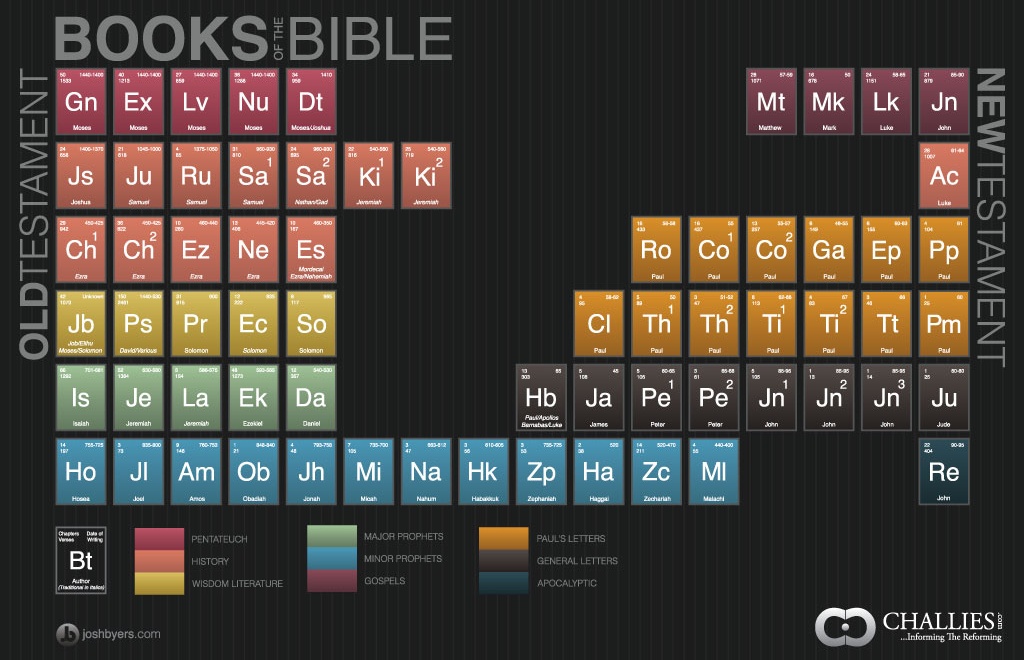
BOB – Numbers

by Stephen Rodgers

NUMBERS IN 10 WORDS OR LESS

“Faithless Israelites wander forty years in the wilderness of Sinai.”

TITLE

The English title “Numbers” comes from the Greek word (Arithmoi) meaning “numbers,” (referring to the census and numberings of chapters 1-4 and 26) whereas the Hebrew title is derived from the books’s very first word (bemidbar), translated “in the wilderness.” (Num 1:1)

As previously mentioned, it is sometimes referred to as the “Fourth Book of Moses.”

AUTHOR & AUDIENCE

Both Jewish and Christian traditions attribute the five books of the Pentateuch primarily to Moses. Like Leviticus, Numbers makes explicit claims regarding Mosaic authorship (Num 33:2; 36:13).

Furthermore, both the OT (Num 33:2; Jos 8:31; 1Ki 2:3; 2Ki 14:6; Ezr 6:18; Neh 13:1; Dan 9:11,13; Mal 4:4) and the NT (Matt 8:4;Mk 12:26; Lk 16:29; 24:27, 44; Jn 5:46; 7:22; Ac 15:1; Ro 10:19; 1Co 9:9; 2Co 3:15) credit Moses as the author of the Pentateuch.

For more information, see the “Author and Composition” section of the Pentateuch article.

The original audience were the Israelites who survived the desert wanderings, and their descendants. Later generations would read it to remind themselves of God’s faithfulness to His people.

DATE

Depending on whether one subscribes to an early (ca. 1,446 BC) or late (ca. 1,260 BC) date of the Exodus would determine the time during which Numbers was written (after the Exodus but prior to Moses’ death). (It should be noted that while good arguments have been put forth in favor of both dates, the majority of scholars surveyed for this series tended to favor an early date).

Given the internal dates supplied in Numbers, we also know that Numbers was written during the final year of Moses’ life.

BACKGROUND & SETTING

Most of the events of the book of Numbers are set “in the wilderness” as the name suggests. Because of their sin, complaining, and lack of trust in the LORD, God condemns them to wander in the desert until the present generation dies off. Numbers 1:1-14:45 records events that took place the year following the Exodus; Numbers 20:1 and following takes place 37-38 years later.  Numbers 15:1-19:22 are undated, but probably took place in the intervening time period. The lack of material associate with this period (compared with the other years of the journey from Egypt to Canaan) communicates how utterly wasted these years were because of Israel’s rebellion.

HISTORICAL & THEOLOGICAL THEMES

In broad terms, Numbers deals with three themes: 1) God’s mercy and faithfulness, 2) God’s justice, and 3) Hope.

  1. We continually see God guiding (Num 9:17) and comforting His people as He offers them forgiveness and reconciliation.  Their rebellions and unfaithfulness are contrasted with His ever faithful love for His own (Num 14:18).
  2. Complaining (Num 11:1-12:16; 21:1-22:1) and rebellion (at both Kadesh and Peor) are followed by judgment and punishment.
  3. Although followed by judgment and punishment, rebellions are also followed by repentance and renewed hope and obedience.  Ultimately, God does not leave His people to wander in the desert, but remembers His promise and brings them to the border of the Promised Land.  Despite their disobedience, His plan and will cannot be thwarted.

LITERARY FEATURES

Numbers as a book falls into the overall genre of historical chronicle.  However, the specific structure of the book is divided into sections of narrative interspersed with sections of laws and regulations.  Such sections should not be viewed as an interuption to the story, but rather seen as expressing religious truths in a visual form.  Remember that as a theocracy, one cannot entirely separate religious ritual and practice from political governance.  In that way, even those rituals serve to further illustrate the narrative portions as complementary material.

INTERPRETIVE CHALLENGES

There are a number of challenges that are presented by the book of Numbers.  The most often cited include 1) whether Numbers is coherent as a part of the Pentateuch, 2) whether Numbers is coherent in and of itself, 2) mathematical issues posed by the reported number of fighting men in Israel, and 3) how to responsibly handle the passages that relate to the false prophet Balaam.

  1. I have already briefly addressed the issue that the Pentateuch should be considered a single collection of work by a singular author (admittedly with minor revisions and glosses that are widely recognized) rather than a collection of writings compiled at a later date.  While Numbers can seem like something of a deparature from the other books of Moses, it should be noted that the author assumes the events (and knowledge of the events) described in Genesis, Exodus, and Leviticus.  There is no additional explanation of the LORD, Moses, the Law, the tabernacle, or the Exodus from Egypt. (Furthermore, see the chart in the ESV Study Bible labelled “Parallels between Exodus and Numbers” for additional similarities and ties).
  2. Some scholars have suggested that Numbers is not a coherrant work.  However, an examination of the book itself clearly shows that the 1st generation of Israel (Num 1:1-25:18) is contrasted with the 2nd generation of Israel (Num 26:1-36:13). Furthermore, as previously mentioned, the book has a distinct beginning, middle, and end from a chronological point of view.
  3. I will address this in greater detail in the OBJECTIONS section below.
  4. Numbers 22:2-24:25 records the rather strange tale of the heathen prophet Balaam.  On an initial reading, Balaam can be a confusing figure, particularly because while he claims to know the LORD (Num 22:18) and even communicates with Him (Num 22:20), God is later shown to be angry with him for going on the very trip that He seemingly gave Balaam permission to take (along the way, there’s a talking donkey, but that’s another issue)!  Balaam then goes on to deliver a true prophecy given to him by God himself…only to have Scripture identify him repeatedly as a false prophet (Deut 23:3-6; Jos 13:22; 24:9,10; Neh 13:1-3; Mic 6:5; 2 Pet 2:15,16; Jude 11: Rev 2:14).  Meinolf Mellwig once described this as an occasion where “you’re not sure how you’re supposed to feel about someone until you read later in the Bible.”  For now, suffice to say that Balaam was a false prophet who the LORD used to speak true words.

OBJECTIONS

The ESV Study Bible (“The Large Numbers in the Pentateuch”) does an excellent job of treating this subject, but I want to briefly sketch an outline for you in support of a literal reading of the numbers.

When taken literally the numbers of the Israelite militia total 603,550 in the first census and 601,730 in the second census, which would seem to imply a total population of 2 to 3 million. Critical scholars have challenged this interpretation by pointing out a number of alleged external and internal problems.

External problems include the inability of the Sinai region to support that many people (explained by God’s miraculous provision), and the lack of archaelogical evidence that such a group ever occupied the region (explained by the fact that such ANE nomadic cultures typically left little to no trace to begin with).

Internal problems include the issue of the firstborn and the problem of small subsequent armies, which I will describe in more detail below:

  • Given that Numbers 1:46 and 2:32 would seem to indicate a total male population of approximately 1 million,  and that Numbers 3:43 tells us there were 22,273 firstborn, initial calculations might lead us to believe that the average family contained…40-50 males.  That seems odd.  A more likely explanation (that still is in keeping with the text) is that the firstborn males are those who were born after the Exodus but before the census.  Assuming a likely demographic breakdown of the 603,550 males (in terms of age) along with a plausible marriage rate would account for that number without issue.
  • The problem of small subsequent armies deals with the issue that despite this enormous number of troops, later records indicate smaller numbers of soldiers: 40,000 (Jos 4:13; Jdg 5:8), and 30,000 (Jos 8:3). Such discrepancies can be explained by the fact that in some cases Scripture records that their  commanders were unpopular (Jdg 4:8), that forces were kept in reserve for guard duty and defensive actions, and/or that commanders only deployed  as many men as they deemed as necessary to accomplish their objectives.
Furthermore, other portions of Scripture seem to support a literal understanding of the numbers (Ex 12:37; Ex 38:26) and we know from archealogoy that Pharaoh Merneptah encountered Israel as a significant people around 1230 BC.

NOTABLE QUOTABLES

  • Numbers 14:18
  • Numbers 23:23

DID YOU KNOW?

  • A mysterious punctuation mark called an “inverted nun” appears only in Numbers and in Psalms.  It’s precise meaning is unclear.

Other Works Referenced

The Glorious Gospel (Part 7)

by Pastor Patrick Cho

Several years ago, I remember counseling a young man who was struggling with his faith. This individual thought he loved God but still wondered if his profession of faith was sincere. Although he had prayed that God would be gracious to save him, he struggled with recurring sins that caused him to doubt. Many believers come to this struggle at one point or another during their Christian lives. Having a valid concern in wanting to make sure they get the gospel right, they scrutinize their lives for the evidence of genuine salvation. Part of the reason for a believer’s doubting their faith is because of confusion regarding what the Bible teaches on the assurance of salvation.

A person’s eternal security and their assurance of salvation are two sides of the same coin. It comes down to the different perspectives of their salvation. Eternal security looks at an individual’s salvation from the perspective of God. Certainly God knows who are His people and who are not. He knows who the genuine followers of Christ are as well as who the pretenders or rejecters are. Eternal security is objective in that it is based on the truths of Scripture and the faithfulness of God to His promises (cf. Titus 1:2). Because of this, it is unchanging. Once God saves a person, their salvation is completely secure in Him. Paul writes about this security in Romans 8:29-39. Christ is the one who establishes the golden chain of salvation (Rom. 8:29-30), so that no one can stand against His elect to condemn them (Rom. 8:31-34). Once a believer is saved by God’s grace, nothing can separate them from the love of Christ (Rom. 8:35-39). From this perspective, salvation is entirely God’s work. He begins it, He sustains, and He is sure to finish it (cf. Phil 1:6).

The assurance of salvation, however, is from our own perspective on salvation. Our sense of assurance is the feeling of whether or not we are saved. It is critically important to understand that our assurance of salvation should rest in the promise of eternity security. We should feel secure in salvation because our salvation is secure in Christ. God doesn’t change His mind about our salvation and promises that once we are saved, we will always be saved (cf. John 10:9, 16, 27-28). Still, the assurance of salvation, unlike eternal security, is subjective and fluctuates. This is because our feeling of assurance is contingent upon our obedience to God. While our salvation is completely sustained by God, our feeling of salvation can be sustained by man. This is why James says things like, “I will show you my faith by my works” (James 2:18). Likewise, the Apostle Paul could affirm the salvation of the Thessalonians because of what he witnessed in them (1 Thess. 1:1-10).

There is significant danger in mistaking these two things. Some people have a sense of assurance without the reality of eternal security. In other words, they might feel saved but are not really saved. This might be the case with someone who trusts in some shallow confession of faith. Perhaps they prayed a prayer when they were a child but since have not walked in faith. Their lives are all about themselves and not about Christ, and even a general perusal of their life evinces that Christ is really not a part of who they are at all. This could also describe someone who trusts in a different gospel or even in his works to save. Sadly, many people will stand before Christ one day thinking they are saved when they are not (Matt. 7:21-23).

On the other hand, there are also those who have eternal security in Christ, but who struggle with a sense of assurance. In other words, a person may really be saved, but still not feel saved. This tends to describe the person who doubts the power of the gospel because of recurring sin in their life. Sin stands in the way of their having complete confidence in their salvation.

So, how can you know if you are a Christian? As was mentioned in the previous article in this series, it must begin with “God saved me.” We stand secure in Christ because God promised salvation through Jesus’ redeeming work on the cross. This salvation shows itself through the evidence of a life that has been changed by God. The Christian can see the fruits of saving faith in his life (cf. 2 Cor. 5:17 – old passed away, the new has come). Paul could proclaim as a follower of Christ that he died to himself and lived for Christ (Gal. 2:20).

We must understand that our deeds do not sustain our salvation. Salvation is entirely God’s Work – to begin, sustain, and complete. But our works demonstrate the genuineness of our salvation and confirm that God has saved us. It is possible that at times true Christians will struggle with their faith, so we must remember that this work of change will not be completed in this life. As long as we live this life in the flesh, we will be tainted by sin. Our hope must rest in God who saves by grace and is faithful to His promise. We are not saved because we live our lives to deserve salvation. We are saved because (in spite of our ill-deserving selves) there is a loving God who desires to show us mercy, grace, and love.

Praying Always

by Charles Haddon Spurgeon

From Ephesians 6:18

What multitudes of prayers we have put up from the first moment when we learned to pray. Our first prayer was a prayer for ourselves; we asked that God would have mercy upon us, and blot out our sin. He heard us. But when He had blotted out our sins like a cloud, then we had more prayers for ourselves. We have had to pray for sanctifying grace, for constraining and restraining grace; we have been led to crave for a fresh assurance of faith, for the comfortable application of the promise, for deliverance in the hour of temptation, for help in the time of duty, and for succour in the day of trial. We have been compelled to go to God for our souls, as constant beggars asking for everything.

Bear witness, children of God, you have never been able to get anything for your souls elsewhere. All the bread your soul has eaten has come down from heaven, and all the water of which it has drank has flowed from the living rock-Christ Jesus the Lord. Your soul has never grown rich in itself; it has always been a pensioner upon the daily bounty of God; and hence your prayers have ascended to heaven for a range of spiritual mercies all but infinite. Your wants were innumerable, and therefore the supplies have been infinitely great, and your prayers have been as varied as the mercies have been countless.

Then have you not cause to say, ‘I love the Lord, because He hath heard the voice of my supplication’? For as your prayers have been many, so also have been God’s answers to them. He has heard you in the day of trouble, has strengthened you, and helped you, even when you dishonoured Him by trembling and doubting at the mercy-seat. Remember this, and let it fill your heart with gratitude to God, who has thus graciously heard your poor weak prayers. ‘Bless the Lord, O my soul, and forget not all His benefits.’

2.6a

Weekly Links – Update (10/28/2011)

by Stephen Rodgers

Normally I would just save these for next week, but a couple of them are time-sensitive, so I’ll make an special update.

  • Until October 31st, christianaudio.com is giving away free copies of Martin Luther: In His Own Words.
  • Until October, 31st, Ligonier Ministries is giving away free copies of The Barber Who Wanted to Pray.
  • Steve Lawson has updated his series with an article on John Calvin.

That is all.

Pro Rege

Weekly Links (10/28/2011)

Now suppose both death and hell were utterly defeated.  Suppose the fight was fixed.  Suppose God took you on a crystal ball trip into your future and you saw with indubitable certainty that despite everything — your sin, your smallness, your stupidity — you could have free for the asking your whole crazy heart’s deepest desire: heaven, eternal joy.  Would you not return fearless and singing?  What can earth do to you, if you are guaranteed heaven?  To fear the worst earthly loss would be like a millionaire fearing the loss of a penny — less, a scratch on a penny. (Peter Kreeft, Heaven)

by Stephen Rodgers

Welcome to Friday!  Hopefully you’ve arrived not too much the worse for wear.  Regardless, here’s a few links to give you something to sink your teeth into…

See you Sunday! (Or tonight, if you’re in my flock!)

Pro Rege

From Fireflies to Sonlight

by Lillian Kim

I have had the joy of serving on Fireflies staff for a total of four-and-a-half years. And now I have the joy of serving on Sonlight staff alongside my wonderful husband, Abram Kim.

The decision to switch from Fireflies to Sonlight wasn’t a very hard decision for me to make but it was a hard transition to go through. When Abram and I got engaged last April, we began talking about our future family and how our ministry would look like as a family. When we talked about my involvement in Fireflies, Abram was fine with me continuing on since it fit under the umbrella of Children’s ministry. We’d still attend the monthly children’s staff meetings together and he’d have more perspective from me on what goes on in the life of a Firefly kid so that it could help him understand how all the ministries of children’s ministry from newborns to eleven-year-olds connect. But as we thought about it and prayed about it more, we both realized that I would be a more effective helper for Abram if I served alongside him in Sonlight. I would be able to give him perspective and insight as I served with him on Sundays to encourage him to grow as teacher, to be his biggest cheerleader, to be his biggest critic, and to know how to better pray for him and help him prepare to teach on Sundays and to lead the ministry. Along with that, we would be ministering to the children, parents and staff together and would be able to talk about the joys and struggles and how to pray and watch the ministry grow as the Lord would be the ultimate leader of the group. So with that, it was easy to make the decision because my heart’s desire since being engaged to Abram is to carry out the words of Scripture, to be his “suitable helper.”

However, the transition was a bit difficult to go through. How do you say farewell to a wonderful staff and an energetic group of babies, infants and toddlers? It’s just hard because the staff is so supportive and loving and of one mind in passing on the glory of God to the next generation. And the kiddies are just so cute and impressionable and are very interested in knowing the truths about God—that he is good, big, everywhere, and that God always wins, Jesus is the boss, Jesus is my friend, Jesus is alive…and the list continues.

God is gracious and he made moving from Fireflies to Sonlight smooth. The Sonlight staff is wonderful and the children are great. Also, it’s neat to see how the Children’s Ministry’s philosophy of ministry is consistent and constant with what the church-at-large stands for. It’s not just that way on paper but it’s also that way in practice.

I’m currently working with the yellow table which is the Kindergarten table. The last interactions I had with these kids were in nursery. It’s been fun and a huge blessing to see how much these kids have grown and learned since their Fireflies days. I can see how the foundations laid out in Fireflies has really helped them in their spiritual journey. Some of the things they’ve been learning this year in Sonlight–like adoption, justification and sanctification–are very big concepts, but they are slowly getting it because they have learned truths about God and Jesus over the course of their participation in the Children’s Ministry here at LBC.

Working with the children of our church is such a delight. The parents have been very helpful as they teach and pass on the glory of God to them. As a church, let’s continue to strive in this endeavor to pass on the glory of God to those who do not know Him.

BOB – Leviticus

by Stephen Rodgers

LEVITICUS IN 10 WORDS OR LESS

“A holy God explains how to worship Him.”

TITLE

The English title “Leviticus” comes from the Greek word (Leuitikon) meaning “about the Levites,” whereas the Hebrew title is derived from the books’s very first word (wayyiqra’), translated “And He called.” (Lev 1:1)

As previously mentioned, it is sometimes referred to as the “Third Book of Moses.”

AUTHOR & AUDIENCE

Both Jewish and Christian traditions attribute the five books of the Pentateuch primarily to Moses.  Like Exodus, Leviticus makes explicit claims regarding Mosaic authorship (Lev 1:1;4:1; 6:1; 7:38; 25:1; 26:46; 27:34) as does the New Testament (Rom 10:5).

Furthermore, both the OT (Num 33:2; Jos 8:31; 1Ki 2:3; 2Ki 14:6; Ezr 6:18; Neh 13:1; Dan 9:11,13; Mal 4:4) and the NT (Matt 8:4;Mk 12:26; Lk 16:29; 24:27, 44; Jn 5:46; 7:22; Ac 15:1; Ro 10:19; 1Co 9:9; 2Co 3:15) credit Moses as the author of the Pentateuch.

For more information, see the “Author and Composition” section of the Pentateuch article.

The original audience were the post-Exodus Israelites, in particular the Levites (although the material in the book deals with the laity as well). Later generations of Israelites would have studied the book to learn God’s laws for worship and sacrificial practices.

DATE

Depending on whether one subscribes to an early (ca. 1,446 BC) or late (ca. 1,260 BC) date of the Exodus would determine the time during which Leviticus was written (after the Exodus but prior to Moses’ death). (It should be noted that while good arguments have been put forth in favor of both dates, the majority of scholars surveyed for this series tended to favor an early date).

BACKGROUND & SETTING

Let me begin by pointing out that Leviticus picks up almost exactly where Exodus left off.  However, whereas Exodus primarily concerns itself with the revelation of the moral law, Leviticus focuses more on the revelation of the ceremonial law.

Prior to Mt. Sinai, a number of events had never previously occurred: the presence of God’s glory had never formally resided among the Israelites, a central place of worship had never existed, a structured and regulated system of worship had not been given, and a formal priesthood had not been appointed to function in conjunction with that system of worship.

Up to this point, Israel had only the example of the patriarchs from which to derive their knowledge of how to worship and live before their God.  Coming off centuries of slavery in Egypt however, even these examples were apparently influenced by polytheism and pagan ritual (as evidenced by the golden calf incident in Ex 32).

Unlike the previous two books, no geographical movement occurs in this book.  The people of Israel are encamped at the foot of Mt. Sinai at the beginning of the book of Leviticus, and they are still there one month later when the book of Numbers begins.

HISTORICAL & THEOLOGICAL THEMES

In broad terms, Leviticus deals with three themes: 1) Holiness, 2) Sin/Sacrifice/Atonement, and 3) Worship.  Let’s examine each in some greater detail.

  • Holiness: the core theme of Leviticus is holiness, both the holy character of God and the will of God for Israel’s holiness.  God’s holiness is seen as the necessary pre-condition to make the mandate of personal holiness intelligible.  The motive for such holiness is seen in two repeated phrases, “I am the LORD” and “I am holy,” which are used more than 50 times.
  • Sin/Sacrifice/Atonement: Since no human is perfect, God provided the sacrificial system as a means of atonement for sins against Him and His law. This is in direct contrast with the underpinnings of other ANE sacrificial systems (see OBJECTIONS).
  • Worship: With the establishment of the Tabernacle, God has fulfilled His desire to be present with His people and enjoy fellowship with them. The only acceptable response to this is an appropriate worship to acknowledge who He is, what He has done, and express their love, honor, thanks, and praise.

LITERARY FEATURES

Leviticus is most obviously a handbook of laws and regulations in the form of an oracular directive from a divine Lawgiver.  The phrase “and the LORD spoke to Moses” appears more than 30 times in the book, underscoring the fact that Leviticus is meant to be received as the very words of God.  In fact, a student at a European Bible college once enthused to me that his appreciation of Leviticus stemmed from the fact that of all the books of the Bible, it has the “highest percentage of God talking.  The whole books is almost entirely God talking.”  Granting the fact that we hold all Scripture to be the words of God, I trust you see his point.

From a somewhat different literary perspective, Leviticus has affinities with utopian literature. Literary utopias both describe how people live in an ideal society and also offer an explanation of the institutions and practices that produce the society described.

INTERPRETIVE CHALLENGES

The interpretive challenges involving Leviticus can be generalized into two groups: internal challenges and external challenges.

  • Internal challenges typically revolve around questions of how to relate and reconcile the “rituals” of chapters 1-16 with the “ethics” of chapters 17-26.  While there certainly isn’t a 1:1 correspondence between the two sections, it would be unwise to assume that they are two unrelated bodies of material. Both are equally concerned with Israel’s holiness to the LORD.
  • External challenges typically revolve around the sociological/historical context of the content.  This is difficult today both because we are far removed from the culture of the ANE, and because Moses didn’t explicate it in great detail, but rather assumed  a certain context of historical understanding. The spiritual principles of the rituals are timeless, being embedded in the nature of God.  The rituals themselves are no longer valid since the church is now under the authority of the New Covenant, not the Old (Heb 7-10).

OBJECTIONS

Objections to Leviticus typically fall into two groups: the sociological group and the moral group.

The various sociological objections have been briefly discussed in the previous section, and for the sake of brevity, will not be dealt with again beyond that.

The moral objections however will be discussed (albeit briefly as well).  These objections generally center on the alleged barbarity of a system of sacrificial atonement, and/or the alleged injustice of a system of sacrificial atonement (incidentally, keep these in mind when we get to the Gospels…they’ll be back).

  • Objections to the barbarity of the system could be treated simply as sociological, but to only do so would overlook the distinctiveness of the Israelite system.  The Israelites were hardly unique among their ANE neighbors in sacrificing animals to deity, but the differences were profound.  Other ANE tribes sacrificed animals because they anthropomorphised their pantheon; they assumed their gods had the same desires and appetites as their worshipers.  In this way, sacrifices were essentially nothing more than quid pro quo…a divine form of graft if you will.  In contrast to their neighbors, Israel didn’t offer sacrifices to curry temporary favor, rather they offered sacrifices to atone for sin. That’s the difference between a man-centered system and a God-centered system: the former is bribery and the later is worship.
  • Objections to the injustice of the system typically revolve around the acceptability of vicarious redemption.  In other words, is it “fair” for someone or something to pay the price for your wrongdoing?  Again, we’ll deal with this in greater detail when we get to the Gospels, but for now let’s simply point out that if ad arguendo there is a supreme, sovereign, divine Being…then His rules by definition are correct.

NOTABLE QUOTABLES

  • Leviticus 11:44
  • Leviticus 17:11

DID YOU KNOW?

  • Unlike other religions with viewed sacrifices as literally “food for the gods” (Eze 16:20; Psa 50:9-13), Leviticus portrays the Jewish sacrificial system as being metaphorically “food for God” (Lev 21:6, 8, 17, 21; 22:25).
  • We often use the phrase “eye for an eye, tooth for a tooth” when describing vengeance, but the Biblical basis for it is justice.  Regardless of who had been wronged, the punishment was not to exceed the crime (Lev 24:20).
  • The blood sacrifices of Leviticus are specifically contrasted with the death of Christ on the cross in Hebrews 7:27.

Other Works Referenced