Author Archives: Stephen Rodgers

Weekly Links (6/17/2011)

[When Paton declared his intention to take the gospel to the New Hebrides islands] a Mr. Dickson exploded, “The cannibals! You will be eaten by cannibals!” The memory of Williams and Harris on Erromanga was only 19 years old. But to this Paton responded:

Mr. Dickson, you are advanced in years now, and your own prospect is soon to be laid in the grave, there to be eaten by worms; I confess to you, that if I can but live and die serving and honoring the Lord Jesus, it will make no difference to me whether I am eaten by Cannibals or by worms; and in the Great Day my Resurrection body will rise as fair as yours in the likeness of our risen Redeemer. (HT: John Piper)


by Stephen Rodgers

Since we’re running out of time before they leave town, I thought this would be an appropriate time to take a quick break and do a missions-themed Weekly Links.

First of all, if you’re looking for a broad overview of word missions, then there are a few sites you should be aware of:

And of course, if you’re looking for a small treasure-trove of missions-related materials, you could do far worse than check out what John Piper and DG have made available.

Meanwhile, here’s a few articles to help you be missions-minded whether you are going, sending, or sent:

See you Sunday!

Pro Rege

LBC Nursery

by Becky Areekul

My journey with LBCSD nursery started when I was a junior in college. At that time I was a new member in the church, and I was looking for a ministry in order to serve and grow spiritually. With my very limited experience caring for young children I thought that joining the nursery ministry would be a great place to start learning this womanly trait. I realized that if I served in the nursery I would not only learn about children, but I would also have opportunities to build relationships with the moms at our church.

After the first few times of being scheduled in the nursery I was struck with great surprise. I didn’t realize how exhausting it was to spend two to three hours with 15 kids! For the first three months serving in nursery I remember going home immediately after Sunday School and passing out for at least two hours. Moreover, my initial perception that children are always perfectly cute and sweet was shattered by the reality of sin. To this day I see willfully sinful attitudes in the kids as they rebel against authority. This was the most humbling aspect of this ministry. Not only was I seeing rebellion and poor attitudes in these kids, but I also saw my own depravity in its most natural form. The only difference between my sin and their sin was my sophisticated tactics of hiding it or concealing it behind a mask of piety.

Serving in the nursery has provided me with a greater understanding of the weight of responsibility that we have to pass on the greatness of God to the next generation (Psalm 78:4). During my six years of service I’ve witnessed most of the kids grow and mature with godly teaching and discipline. By God’s grace I’ve been able to witness the fruits of godly parenting and the effects of raising children in the church body. I believe the greatest spiritual growth I gained through this ministry is learning how to love each child as individuals, to allow them to be the person God has created them to be, but also to temper that with teaching them about God and His righteousness. When I joined this ministry I sought to learn what it takes to love and care for children and to build relationships with the moms; I can now say with certainty that God has definitely grown me in these areas.

In addition to spiritual lessons I’ve also experienced many funny moments with the kids. Most of those times involve some kind of poo incident. The greatest lesson was learning that I should be absolutely certain that the child is finished with their pooing efforts before I attempt to change their diaper. My most memorable incident was trying to change one the young ones and not realizing they were not finished; as I was wiping them I had diarrhea squirt all over my smock and arm. Now when we have new nursery staff I try to teach them all the tricks and things to watch out for, especially when changing a poopy diaper.

As my service in the nursery at LBCSD is coming to an end (Ted and I will be moving to San Jose to join the church plant after our wedding), to our nursery staff I would encourage all of you to love the children as Christ loves the little ones. Ask God to reveal to you the significance of passing on the greatness of Him to the next generation and pray for wisdom to do it accurately. I would also encourage the staff to really get to know the moms that serve with us and also the parents who drop off their kids. We are so blessed to have many older, godly women in the church; use this time to practice the Titus 2 principle and learn as much as you can from these women. Lastly serve and love the kids as an act of worship to God! It’s been such a privilege to serve in the LBCSD nursery.

Peacemaker – Hub Post

by Stephen Rodgers

This is the hub post for Cesar Vigil-Ruiz’s series on The Peacemaker. From this page, you can easily find and refer to all posts in this series.

All posts in the Peacemaker series:

And while each article contains links to study notes, the sermon itself, and related materials, for those of you just looking to download/stream the audio can find the sermon series here.

Peacemaker: Conclusion

by Stephen Rodgers

Since our series on the Peacemaker has come to an end, I wanted to briefly cap it off with some links to related resources.  For those of you who found this series helpful, this would be a great jumping off point to dive deeper into the subject matter.

  • Obviously, there’s the series here on the Beacon. Cesar did a great job summarizing and outlining the chapters for everyone, and he took the series on short notice.  Make sure you give him a high-five the next time you see him.
  • On top of that, there’s the audio of the messages that were taught in the second-hour Sunday School, as well as the Peacemaking for Families messages that the Grace Life group went through.
  • Peacemaker Ministries also maintains a website where they make available some of the more fundamental sections of the book. You can find everything from the “Four G’s” to the “Seven A’s” in there.
  • For those seeking a broader view, they also have a section of key articles which have been published since the book, and focus on specific areas.
  • And if you still want more, they also maintain a blog which is updated several times a week.

In conclusion, I would also point out that the Peacemaker falls under the general category of what is known as “Biblical Counseling,” and if you’re seeking more material on that subject, either the CCEF blog or the BCC blog would be great places to start.

Thanks again for reading.

The Happiest Place on Earth?

by Pastor Patrick Cho

Being at Disneyland this past week, I am reminded of the irony that this is called the “Happiest Place on Earth.” I had the opportunity to people watch a little bit as Eden napped in her stroller, and quite a few very unhappy people walked by consistently. One after the next, I was witness to angry mothers, exasperated fathers, complaining children, and crying babies. I could imagine some of these parents yelling at their children, “You’d better have a good attitude! We’re at Disneyland for crying out loud!”

It was a good reminder of a sermon I once heard by C. J. Mahaney that church is actually the happiest place on earth. C. J., I wholeheartedly concur (because it certainly isn’t Disneyland!). Church is the place where you can find Spirit-filled people who are committed to each other in love. Everything isn’t about simply looking after yourself. This is why the attitudes at Disneyland are so disappointing. It’s a park full of people who do not have a biblical, God-centered, redeemed view of love.

1 John 4:7-8 states that “love is of God” and “God is love.” Without the grace of God to redeem our minds to think His thoughts after Him, we cannot understand this. The natural man simply doesn’t get it. Love is defined by God because God is the definition and source of love. This is why if a person has not trusted in Jesus as Lord and Savior, having received the Spirit of God, he cannot truly grasp what love is. An unbeliever can have a partial understanding of love but not a full one, because the fullest sense of love can only be achieved, comprehended, and practiced in God.

It is no wonder there is so little genuine happiness at a theme park. When you are thinking of yourself, the “fun” is not really worth the long lines, hot weather, expensive food, and crowds of people. It is easy to bicker, complain, and whine. But when in Christ you are considering others more important than yourself, it’s ok to wait in a long line, bear the heat, and pay expensive prices to make sure those who are with you are having a great time.

There is no better place on earth to be than the church in order to see this demonstration of God-pleasing, selfless love. Yes, at times we lose sight of our responsibility to love others this way, but by God’s grace the church gets to display the love of Christ for the world to see.

I still enjoy spending the day at Disneyland, but not because it’s the happiest place on earth. I like the corn dogs and turkey legs. But as enjoyable as Disneyland might be, let’s not lose sight of the fullness of joy we have in Christ. Let’s not forget our call to love one another with the love of God. If we strive for this by God’s grace and through His strength and enablement, we will always rightfully lay claim to the title “Happiest Place on Earth.”

The Things Which Are Not Seen

by Charles Haddon Spurgeon

From 2 Corinthians 4:18

In our Christian pilgrimage it is well, for the most part, to be looking forward. Forward lies the crown, and onward is the goal. Whether it be for hope, for joy, for consolation, or for the inspiring of our love, the future must, after all, be the grand object of the eye of faith. Looking into the future we see sin cast out, the body of sin and death destroyed, the soul made perfect, and fit to be a partaker of the inheritance of the saints in light. Looking further yet, the believer’s enlightened eye can see death’s river passed, the gloomy stream forded, and the hills of light attained on which standeth the celestial city; he seeth himself enter within the pearly gates, hailed as more than conqueror, crowned by the hand of Christ, embraced in the arms of Jesus, glorified with Him, and made to sit together with Him on His throne, even as He has overcome and has sat down with the Father on His throne. The thought of this future may well relieve the darkness of the past and the gloom of the present. The joys of heaven will surely compensate for the sorrows of earth. Hush, hush, my doubts! death is but a narrow stream, and thou shalt soon have forded it. Time, how short-eternity, how long! Death, how brief-immortality, how endless! Methinks I even now eat of Eshcol’s clusters, and sip of the well which is within the gate. The road is so, so short! I shall soon be there.

‘When the world my heart is rending
With its heaviest storm of care,
My glad thoughts to heaven ascending,
Find a refuge from despair.
Faith’s bright vision shall sustain me
Till life’s pilgrimage is past;
Fears may vex and troubles pain me,
I shall reach my home at last.’

1.29a

Weekly Links (6/10/2011)

Ah, believer, it is only Heaven that is above all winds, storms, and tempests; God did not cast man out of Paradise that he might find another paradise in this world. (Thomas Brooks. HT: Josh Harris)

by Stephen Rodgers

Welcome back to another edition of the Weekly Links!  Today we’re going to do something a little bit different.  There’s a free audio book to bring to your attention, but once we’ve covered that, I want to point out a few resources here on the Beacon and the church website that you might not be aware of.

  • So first off, we have a free audiobook for you: Joni Eareckson Tada’s A Place of Healing. If you aren’t familiar with Joni’s story, you really need to check it out.  She’s a woman of amazing courage and strength.

So that brings us to a few other links that are closer to home…

  • As you may know, our missions teams are getting ready to head out to the Czech Republic and Argentina.  And here on the Beacon, we have a Missions category, which is further sub-divided into an Argentina section and a Czech Republic section if you want to review what past teams have done.
  • If you wanted to hear some messages from the pastors that we partner with, we actually have a message from Jorge Ahualli, and three messages from Meinolf Mellwig.
  • Last Sunday, during the Elders Q&A, a number of questions came up.  One lengthy response covered the subject of DTR, and it was mentioned that we had not had a DTR series this year.  However, if you’re interested in such things, you can listen to the first DTR series, the second DTR series, and/or the third DTR series.
  • And if interviews with our elders are something that interest you, we have a recording of last year’s interview as well.

Well, that’s it for this week.  I hope this was helpful to those of you who weren’t aware that we had such resources.

See you Sunday!

Pro Rege

Grace Life Update

by Ivan Cheng

Learning to be a parent is a constant growing process with God and with Nancy. Each day is an opportunity to practice the Four G’s of the peacemaker principle. When our children were infants, parenting was relatively easy with feeding, changing diapers, and putting them to sleep. As they grew older, the issues of behavior, discipline, and how to train our children in righteousness as the Bible commands became more central to parenting. I never imagined that parenting would require so much intentional planning and foresight.

The first G of “glorifying God” sounds simple, yet it takes conscious effort to put into practice. It is easy to just want to parent by reflex, but it ultimately leads to worldly standards. Putting God first means evaluating my attitudes, words, and actions in light of what pleases Him and modeling biblical values to our children.

The second G of “getting the log out of your own eye” has been the most humbling as a parent. Every day I’m confronted by how my own sins may be the cause of the problem in a conflict with our children. My quick temper, my selfish agenda, my unrealistic expectations are really the underlying issues at hand. Praise God for His mercy that each day is a brand new day for God to start afresh to mold me to His likeness!

The third G of “gently restore” is one that I constantly need to monitor. It is easy to crush the spirit of my children with my harsh words and anger even though they have erred and need discipline. I’m learning that the process is to rebuild the relationship and not just about correcting behavior. They need so much more encouragement and affirmation from me.

The forth G to “go and be reconciled” is so easily left out. I can dish out rebuke and discipline, but reconciliation seems such an afterthought. Sometimes I think that I have it all wrong. I spent the majority of the time focusing on correction and only minimal time on rebuilding. Instead, it should be the other way around, focusing on God’s redeeming grace and reaffirming my unconditional love for my children. The main effort should be on moving past the error and restoring the broken relationship through forgiveness and reconciliation.

God has been gracious to allow me to grow as a parent. I’m grateful that God has put Nancy by my side to work together as parents. Each day we are able to come together to evaluate our goals and mistakes as parents, pray, and depend on the Holy Spirit for His wisdom and to transform us to be Christ-like. We are constantly reminded that our goal is not to raise successful children, but ones who have a loving relationship with Christ and experience His grace. Ultimately, we need to trust that God’s plan for our children is far better than anything we can conceive for them.

Peacemaker Chapter 12: Overcome Evil with Good

by Cesar Vigil-Ruiz

Editor’s Note: You can listen to the class and download the handout.

Do not be overcome by evil, but overcome evil with good. (Rom. 12:21)

That verse alone should condemn the majority of conflicts that have arisen in the past, since most people, even those who profess to know Christ, blatantly disregard what God commands here. We seem to see this verse and its message to be a simple and naïve view of real life, not paying attention to the fact that Paul the apostle is writing this having already suffered much at the hands of men for the sake of Jesus Christ and making Him known. This is what Paul realized:

[A] true peacemaker is guided, motivated, and empowered by his or her identity in Christ. This identity is based on faith in the most amazing promise we could ever hear: God has forgiven all our sins and made peace with us through the death and resurrection of his Son. And he has given us the freedom and power to turn from sin (and conflict), to be conformed to the likeness of Christ, and to be his ambassadors of reconciliation (2 Cor. 5:16-20). It is the realization of who we are in Christ that inspires us to do the unnatural work of dying to self, confessing sin, addressing others’ wrongs graciously, laying down rights, and forgiving deep hurts—even when people who persist in opposing or mistreating us. (p.248)

God, in saving us, has not left us alone to deal with our conflicts, but has given us His Word, prayer, truth, righteousness, the Gospel, faith, and the Spirit-filled character (Eph. 6:10-18; Gal. 5:22-23). In his letter to Rome, Paul lays out 5 principles that help make an effective and victorious offense in dealing with conflict (Rom. 12:14-21).

Control Your Tongue

When a dispute gets more loud or intense, it’s at this crucial time that we must control our tongues (Rom. 12:14). We must actively speak gracious truth to those we are in conflict with, speaking well of them and being kind with our language (1 Peter 3:9). By doing this, you also will have a more real view of the situation, as well as a loving attitude. This will continue dialogue, not stifle it.

Seek Godly Advisors

Find men and women who will be biblical in their advice and not be afraid to correct and admonish you when they see you in the wrong (Rom. 12:15-16; Pro. 27:5-6). “If a lack of noticeable progress causes you to doubt the biblical principles you are following, you may be tempted to abandon God’s ways and resort to the world’s tactics” (p.250). This is why godly advisors can help you stay on course, especially when it’s hard.

Keep Doing What Is Right

Whether the person who is against you responds positively or negatively is irrelevant when it comes to you doing right (Rom. 12:17). You need to be careful in your planning and acting that when anyone can see how you are during this conflict, they should reason that you are in the right (1 Peter 2:12, 15; 3:15b-16; 1 Sam. 24:1-22).

Recognize Your Limits

Do whatever you can to be reconciled or at peace with others, knowing that you cannot force anyone to do what is right (Rom. 12:18). This is all God asks of you, and you do not have to keep trying to solve the problem when the other person continually refuses you. To succeed is to be faithful in obeying God’s will (Ecc. 12:13b). Knowing your limits is specifically related to your temptation of wanting to exact revenge on the one who does you wrong. You are not God, for He will mete out justice and punish the unrepentant (Rom. 12:19; Pro. 20:22). He uses the church (Matt. 18:17-20), the civil courts (Rom. 13:1-5) or even Satan (1 Cor. 5:5; 1 Tim. 1:20) to deal with them. Following God’s revealed will is always the best way to go.

Use the Ultimate Weapon

The ultimate weapon, according to Rom. 12:20-21 is deliberate, focused love (cf. Luke 6:27-28; 1 Cor. 13:4-7). What Christ calls of His own is to find whatever your opponents’ deepest needs are and meet them. This may come out in showing them their faults, showing them compassion, patience, words of encouragement, or even providing material and financial help to those who are least deserving or who even least expect it from you. “As we love our enemies and seek to meet their needs, we can glorify God and protect our souls from the acid of bitterness and resentment…God may use our loving acts to soften the hearts of our opponents” (p.255). Pray that our church and our individual lives would reflect the love of Christ to a lost and dying world, especially when we least think about it: during conflicts.

Gray Issues Part 3 – Are you struggling? Great!

by Elder Peter Lim

So last month, I wrote about the fact that trying to define the line that separates “sin” from “not-sin” is not simply a matter of following a list of dos and don’ts from the Bible. It’s always a matter of the heart. I also wrote in Introduction to Gray Issues that I was somewhat frustrated by the lack of clarity in my search of Scripture for answers to my questions regarding gray issues. I wanted to expand upon that thought a little more today.

It’s not really a lack of clarity in Scripture that frustrates me but rather a tendency in my own heart to simply desire to know what decisions to make practically. I’d rather not have to wrestle through every situation and examine my heart’s motives. Instead, it’s easier to just make a blanket policy of life to say “if it’s not sin, then I can do whatever I want” without ever considering why I would even want to do those things in the first place. The frustration comes when the Bible doesn’t make it very clear what the blood alcohol level has to be before being considered drunk, or whether PG-13 is okay but R is questionable and NC-17 is definitely not okay, or sharing a dorm floor with coeds is okay but sharing a tent is not okay, or gambling away $100 is okay for entertainment value but $500 is financial  irresponsibility. But the Bible does make certain things perfectly clear: We still have fleshly tendencies although we are not of this world. (Rom. 7:14, Phil. 3:20) So did God place these nebulous commands such as 1 Peter 2:12 (“Keep your behavior excellent among the Gentiles, so that in the thing in which they slander you as evildoers, they may because of your good deeds, as they observe them, glorify God in the day of visitation.”) to frustrate us? What exactly does it mean to keep our behavior “excellent?” Would it be sin if we didn’t keep our behavior excellent? Yes, right? Then wouldn’t it be important to define what that word means so that we would not cross it? This is what I mean when I say that it’s somewhat frustrating that things are not so clearly defined.

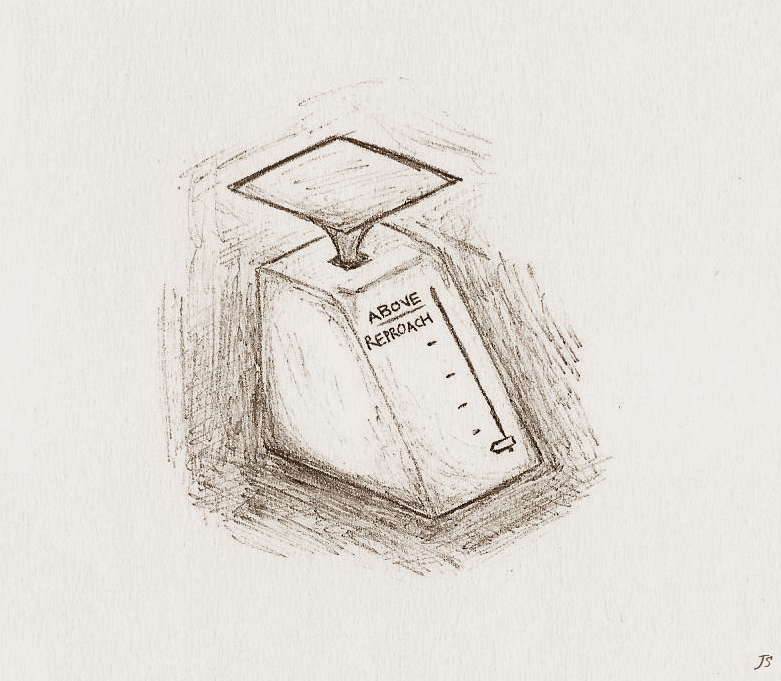
But hold on a minute. This is exactly what God intended for us to struggle with. You see, dear Christian, that God in His infinite wisdom gave these sorts of instructions to us in order to help us recognize our own sinful tendencies. He did this on purpose so that we would realize that our hearts are full of sin and then go humbly pleading on our knees to Him who paid the price for us. The struggle itself is a good thing. Remember that it’s always a matter of the heart. Fine, so we realize that. So now what? Can I still do these questionable things? Listen to yourself. If it’s questionable, why would you want to do them? Why wouldn’t you want to stay far away from the edge of the cliff? The answer to the question is, no we must not do questionable things. We are called to be above reproach. That means that we are going to have to want to voluntarily give up activities that are not necessarily sinful because the glory of God is at stake, and being above reproach becomes more important to us than fulfilling our fleshly desires.

Truth is, we’re always going to be in a battle against ourselves. Our fleshly selves are going to want to sin. Our spiritually renewed minds are going to want to fight against sin. There is hope here. As we grow and mature, we will sin less. But we will also grow in our understanding of how hideous sin is to God. So we will sin less and feel worse about it. This is the kind of godly remorse which causes us to remain humble even while we grow closer to Christ. Remember that the closer you get to the light, previously unseen blemishes are revealed. That’s how we know we are growing. Therefore, struggling (against sin) is a good thing!