Author Archives: Stephen Rodgers

LBC Weekly SPARK – March 17, 2011

by Pastor Patrick Cho

Dear LBC family and friends,

By now, I’m sure you’ve all been aware of the disastrous tsunami that hit Japan and the devastating effects of its aftermath. Please pray for our brothers and sisters who are there ministering to the needs of those who are suffering and representing the true gospel of Christ. It’s in times like these that the church is called to band together and pray as one. Please take some time to pray for Japan today.

As tragic as events like these are, they also serve as a sobering reminder of the frailty of this life and the curse of death in the world. Life is short and tomorrow certainly is not a guarantee. As I’ve preached recently from the pulpit, if you knew this day would be your last, how would you spend it? The person who has a clear understanding of the brevity of life, and who understands that an eternity of heaven or hell is to come, typically will not allow sin to go unchecked in his life. He’ll live in anticipation of his coming King. He’ll represent Christ in this lost and dying world.

As we consider the hardships of those in Japan and offer up our prayers for that nation, let’s pray that God would work to turn what is a generally atheistic nation to Him. Let’s also be reminded that this life is not the end. This earth is not our home, but our citizenship is in heaven if we truly are in Christ.

In His grace,

Patrick

Here are the announcements for this week:

  1. Friday Night Bible Studies. The youth and SDSU college groups will be having their regularly scheduled Bible studies on Friday night. The UCSD Bible study will NOT be meeting this week due to finals. The college group meets on campus at UCSD and SDSU at 7:00pm. The youth will be meeting at the church, also at 7:00pm. Visit the church website for more information. The singles ministry will not meet for regular Bible study as we have our annual retreat this weekend at Pine Valley Bible Camp.
  2. Sunday Service. Please pray for Peter Lim as he prepares to preach this Sunday while your pastor is away at the singles retreat.
  3. Sunday School. Because of the number of people who are going to be away for the singles retreat, we will be cancelling our Sunday School classes this weekend for both adults and children.
  4. End Times Bible Study. To coincide with our study in 1 Corinthians 15, Pastor Patrick will be continuing his Sunday evening series on end times. Come find out what the Bible says about eschatology through this helpful series. The remaining meetings will be at the church from 6:00-8:00pm on March 20 (this Sunday!), April 3, and April 17. For more information, please talk to Pastor Patrick.
  5. Men’s Breakfast. On Saturday, April 2, at 7:00am, we will be having a men’s breakfast fellowship at the church. Come out as we discuss what it means to be a man of God and enjoy a time of prayer together. Bring a breakfast item to share. Coffee and juice will be provided.
  6. Members Meeting. On Sunday, April 10, we will be having our next members meeting at 4:45pm at the church. Please mark your calendars. All members of LBC are highly encouraged to attend. As always, dinner will be served.
  7. Prayer. Don’t forget to come to church a little early on Sunday for a time of corporate prayer in the sanctuary. The sanctuary will be open for prayer at 8:45am, and prayer requests will be projected on the wall. If you are out in the foyer talking with one another, I would encourage you to remind each other of this time and come in to pray for the church.

Reflections on the College Life Retreat

by Brandon Cai

As many of you probably know from the sudden inflow of pictures of cheery-faced collegians on Facebook, (or if you aren’t an avid user of online social-networking websites), are suddenly hearing ridiculous stories about snowball fights, pantyhose competitions (Editor’s note: it’s not what you think), and dance-offs…it’s that time of the year again. Assuming you’ve been to Lighthouse Bible Church before or personally know some of the collegians, (otherwise this introduction would have been quite nonsensical), Lighthouse recently hosted its annual February College Life retreat at Pine Valley, California.

If you haven’t already scrolled down the page due to lack of interest (I understand) then I must congratulate you. You already know more about the retreat than I did when I loaded my bags into the car and prepared for the trip down to Pine Valley. I did not expect to be pelted by snowballs in a wonderland of white. Nor did I expect to compete against an opposing team member with only a pantyhose over my head and improvised head-twirling techniques. Most of all, I did not expect to be heading off to retreat to be learning about a topic I already knew about, or at least I thought I knew.

The theme of this year’s College Life retreat focused on the grace of God. Reading this aloud to yourself, you may readily accept this given theme without any hesitation. But here already, we have an expression that is contradictory to the character of the God whom we worship. From what I discovered at retreat from our speaker, Dan Nah, pastor of Cornerstone Bible Church, the grace of God simply cannot be defined as “grace.” Rather, there needs to be a defining adjective which, quantitatively and qualitatively, only can satisfy the true attribute of our God’s grace. This is why our theme for this year’s retreat was phrased, the “Scandalous Grace” of our Lord God.

“Okay,” I said to myself, God’s grace can be defined as “bountiful,” “abounding,” “rich,” and the list goes on and on. But out of all the words that could be used to describe grace, why “scandalous?” The point is, Pastor Dan states, some of us one end of the spectrum may know how gracious our God is in our daily lives, but we do not realize just how far His grace encompasses us, even to the worst of sinners. From our reactions towards His grace, it is evident some of us may feel as if His grace does not fully satisfy our sinful nature; we work and work, often with futile efforts to satisfy the Law. On the other end of the spectrum, the nature of God’s grace is so foreign to some that they react in outrage and anger towards the grace of God, desiring to go as far as to murder the One who stops stones from being thrown and restores even adulterers to positions of righteousness. God’s grace is simply put, outrageous in every respect.

There are so many evidences of God’s grace in the Bible, from the splendor of the Garden of Eden given to man in Genesis, even to the last book, Revelation, written to give hope to those who suffer for Christ’s sake. Pastor Dan focused on several books of the Bible that shine the spotlight on just how outrageous God’s grace is. Genesis, 1 Kings, Hosea, Jonah, Matthew – these books all depict numerous accounts of God’s loving good will towards those found righteous or sinful in His eyes.

But what I found most compelling from Pastor Dan’s sermons on scandalous grace was how God’s grace reveals so much more of our Creator’s own character to us. What I discovered in my reflection were four aspects to God’s character that are depicted in the giving of His grace to us.

  1. God is true to His word when He gives it. When God tells Jonah to preach to the city of Ninevah, He does not go back on His word. He forgives all the people of Ninevah and the whole city is saved from disaster in the hands of God. (Jonah 3:10) When God provides Elijah with strength in the wilderness, He does not only give courage in words, but sustains Elijah with food and nourishment. Twice! (1 Kings 19:7) God does not relent in His grace when He decides to give it. He overwhelms us with His grace.
  2. God reveals His glory through His overwhelming grace. What God desires to show in His grace to us is the glory of His perfect, righteous, and holy being. (John 1:14,16) In bringing Elijah strength and sustenance, He reveals His glory to one man. In saving the city of Ninevah, God reveals His glory to a city. In crucifying His Son on the cross, God reveals His glory to the whole world.
  3. God pursues those He saves. In the whole book of Jonah, God graciously pursues Jonah from the beginning in his refusal to preach to the city of Ninevah, till the end when He rebukes Jonah for his hatred of the sinners of Ninevah. God never ceases to give up on the prophet He commissions even when he blatantly disobeys God.
  4. God gives because He loves. 1 John 4:19, states that “God first loved us.” He loved us before the beginning as He foreknew us, He loved us after the Fall of Man, and He continues to love us even when we sin against Him. He so loved the world that He offered as the ultimate act of grace to mankind, the sacrifice of His most precious possession: His Son. (John 3:16) And He gives not according to how righteously we live, but because He loved us first and fully.

Knowing the character of our gracious God not only reveals more of His glory and supreme being, but as Pastor Dan told all of us who went to retreat, the magnitude of our sinfulness as well. The degree to which they offends our Holy God is significantly magnified for us who live in the faith. To know and belong to a Father who loves us so deeply that He desires to give to us more than anyone else could ever give and more than we could ever deserve to receive – this knowledge should heighten our love and deepen our respect to our God who deserves more than we could ever give. It should be the driving force for our hearts in constantly glorifying Him in our daily walk, forever worshipping the God who so graciously extended His hand to sinners who were in complete rebellion against Him. All the glory be to Him forever.

Peacemaker Chapter 2: Live at Peace

by Cesar Vigil-Ruiz

Editor’s Note: You can listen to the class and download the handout.

If possible, so far as it depends on you, live peaceably with all. (Romans 12:18)

Sande continues to write in this chapter of “three dimensions to the peace that God offers to us through Christ: peace with God, peace with one another and peace within ourselves” (p. 44).

Peace with God

What brings peace with God has to do with what the Gospel is. We are all sinners who have strayed away from and fallen short of His perfect standard that leaves us separated from Him: “Behold, the LORD’s hand is not shortened, that it cannot save, or his ear dull that it cannot hear; but your iniquities have made a separation between you and your God, and your sins have hidden his face from you so that he does not hear” (Isaiah 59:1-2). The good news is that God did not leave it there; He offered a way of salvation through the life, death, and resurrection of His Son, Jesus Christ (John 3:16): “By sacrificing himself in our place on the cross, Jesus has made it possible for us to have peace with God” (p.45). What Sande writes here is very important, and worth quoting in full:

Believing in Jesus means more than being baptized, going to church, or trying to be a good person. None of these activities can erase the sins you have already committed and will continue to commit throughout your life. Believing in Jesus means, first of all, admitting that you are a sinner and acknowledging that there is no way you can earn God’s approval by your works (Rom. 3:20; Eph. 2:8-9). Second, it means believing that Jesus paid the full penalty for your sins when he died on the cross (Isa. 53:1-12; 1 Peter 2:24-25). In essence, believing in Jesus means trusting that he exchanged the records with you at Calvary—that is, he took your sinful record on himself and paid for it in full, giving you his perfect record, which opens the way for peace with God. As you believe in Jesus, accept his gracious gift of salvation, and draw closer to him through the power of his Spirit, the study of his Word, the privilege of prayer, and the fellowship of his church, his peace can fill every part of your life (ibid, author’s emphasis).

Peace with Others

This type of peace is also called unity, which is “the presence of genuine harmony, understanding, and goodwill toward people” (p.46). This is what immediately follows after having obeyed the second great commandment, “Love your neighbor as yourself” (Matt. 22:39).

Peace within Yourself

“Internal peace is a sense of wholeness, contentment, tranquility, order, rest, and security…Genuine internal peace cannot be directly obtained through our own efforts; it is a gift that God gives only to those who believe in his Son and obey his commands (1 John 3:21-24)” (p.46).

Jesus’ Reputation Depends on Unity

What unity shows in the life of a Christian community is that you are not of this world, but you are sons of the Most High God (Matthew 5:9). What Sande continues to point out in this chapter is the direct relevance of our Gospel witness to our unity in our relationships within the body of Christ. It is a witness to a watching world that our kind of peace is deeper, purer, and more satisfying than the cheap imitation that is constantly portrayed in the media or at the theaters. Disunity in the church is a poor witness to our call for non-believers to come to Christ and be changed, when we don’t show it ourselves. In Jesus’ high priestly prayer (specifically verses 20-23), he had this in mind. Jesus prayed that his followers would get along with one another. This was so important to him that he tied his reputation and the credibility of his message to how well his followers would display unity and oneness” (p.48). In the oft-quoted passage (Matthew 13:34-35), “The love Jesus commands us to show to one another has little to do with warm feelings; in fact, he commands us to show love even when it is the last thing in the world we feel like doing (Luke 6:27-28)” (ibid). It becomes so important to Jesus how we relate to one another, that to enter into a church to offer worship to God would not please Him if we knew we were not right with a brother (1 John 4:19-21).

The Enemy of Peace

In thinking of our conflicts, we must not forget the lover of conflict, Satan, which means “adversary.” Among many things Satan does, what he loves to get involved in is our tension with one another:

Satan promotes conflict in many ways. Among other things, he tempts us so we give in to greed and dishonesty (Acts 5:3), he deceives us and misleads us (2 Tim. 2:25-26), and he takes advantage of unresolved anger (Eph. 4:26-27). Worst of all, he uses false teachers to propogate values and philosophies that encourage selfishness and stimulate controversy (1 Tim. 4:1-3). (p.51)

What Paul describes (in Eph. 6:13-18) as weapons in our arsenal that we readily have to withstand Satan’s power are:

  1. Truth
  2. Righteousness
  3. The Gospel
  4. Faith
  5. Scripture
  6. Prayer

Even though we shouldn’t blame Satan for all the conflicts that arise among us (since we must take responsibility for wrongs we have personally committed), we tend to overlook the role Satan plays and the influence he has in leading many astray (especially when Scripture reveals this to us).

Strive like a Gladiator

In passages like Romans 15: 5-7, 1 Corinthians 1:10, Galatians 5:19-22, Colossians 3:13, 15, and 1 Thessalonians 5:13b-15 show us is that the New Testament epistles have a heavy emphasis on obeying God in your peacemaking. In Ephesians 4:1-3, Paul uses the word that is translated “make every effort” in the NIV (“eager” in ESV), which means “to strive eagerly, earnestly, and diligently” (p.52). It’s to be done with the same rigor as that of a trainer of gladiator would use when sending men into battle: “’Make every effort to stay alive today!’” (ibid) This is not a passive exercise of pretending things are ok yet never dealt with, or forced to be dealt with in a cold fashion. Peacemaking is the means to an end—Christlikeness, or a display of the Gospel, and neither is easy to show.

We also need to avoid the idea that unity is equal to uniformity. That isn’t the position of Paul in Eph. 4:7-13, since many in the church have a different set of gifts or talents, which is how God distributes His gifts, and that we can hold, as Rom. 14:1 says, different views on “disputable matters” in the NIV (“opinions” in ESV). However, it must not be done in a way which, if you remember from FOF, can grieve (Eph. 4:30) or quench (1 Thess. 5:19) the Holy Spirit.

Lawsuits among Believers

Peace and unity among Christians is so essential to our witness for Christ that God commands us to take unresolved legal issues to the church rather than to the civil courts. Many pastors have neglected to teach regularly on the this passage, so most Christians are completely unaware of this command or believe that it no longer applies. Worse yet, many churches deliberately ignore this passage and do nothing to help their members settle their legal disputes in a biblical manner (p.54, after quoting 1 Cor. 6:1-8)

Having lawsuits among professing Christians not only shows a lack of peacemaking promoted in the church, but also a lack of help for Christians in their conflicts, as well as a further black eye to the church’s testimony of Christ. What Jesus has taught about conflict in Matthew 18:15-20 should serve as a launching pad of loving confronting among the body. With lawsuits, relationships can be seriously damaged, whereas the church can more readily provide and foster forgiveness and reconciliation to one another. What lawsuits resolves are issues of “awarding damages, transferring property, or enforcing a contract” (p.56), not the root cause of all conflict: our sin. Once that is dealt with, material issues become more easy to deal with.

By going to the church, our witness of Christ and His power to change sinners can draw more attention to Him than anything else. It is an evangelistic tool at our disposal: revealing the life-changing power of the Gospel to do what the world tries but simply imitates: real peace. Peace with one another, which comes from a peace with the true God of Scripture, and leads also to a peace within, since it’s birth from a peace outside us, and that’s the only peace that lasts.

What Do People Think of You?

by Elder Peter Lim

Would you like to know what your reputation is? Are you sure? Do you even care? For some of us, this is one of those questions that we want to know the answer to only if the answer is favorable. But some of us actually don’t care what other people think of us. This can be good and/or bad. On one hand, we should do what pleases God despite what people may think of us. On the other hand, we should care about what others think of us as it may have an impact on how we reflect God’s influence in our lives. After all, don’t we want people to think highly of Christians so that they would want to be Christians too? Problems potentially arise when those two values come into conflict with each other.  But no matter what your initial response to my question is, what are the biblical principles that apply? Let’s look at some key passages.

1 Timothy 3:7
And he must have a good reputation with those outside the church, so that he will not fall into reproach and the snare of the devil.

In this qualification for Elders, Paul emphasizes that a man who seeks to be a leader of the church needs to have a good reputation even among non-Christians. Why is the opinion of an unsaved person so important? Because a leader needs to be a man of proven character who is living an exemplary life as a Christian in the midst of non-Christians among whom we appear as lights in the world. Acts 6:3 also points out that we are to select men of good reputation to put in charge of tasks such as serving tables. Of course non-Christians won’t always agree with us what a good reputation looks like. They may accuse Christians of having a bad reputation because we don’t support their sinful causes or beliefs. When we hear from non-Christians that a Christian has a bad reputation, we need to find out more details why they think of someone that way. It very well may be the case that what they consider to be a bad reputation is actually good reputation from a Christian perspective. However, as Proverbs 3:4 says, even a non-Christian raised in a Judeo-Christian-influenced country such as the U.S. can generally exercise good judgment in identifying someone with a good reputation.

Proverbs 22:1
A goodname is to be more desired than great wealth, Favor is better than silver and gold.

Having a “good name” or good reputation is very valuable. Wealth has only a limited value which is temporary at best. Having a good reputation is associated with a life which is in tune with God. It’s valuable not because our good reputation benefits ourselves in some way, but because it reflects on God who lives in us and empowers us to do anything good in the first place. It gives us opportunities to share Christ with those who are attracted to our lives of good repute.

A good reputation is difficult to gain because it takes time and consistency in one’s behavior. However, a bad reputation is easy to earn because all it takes is just a single incident to develop. As Christians who understand that our righteousness is not our own but imputed to us, and that we are empowered by the Holy Spirit to do good works, we have nothing to boast of other than Christ’s work in our lives. Scripture is clear that our reputation matters to God and men. We must care about what others think of us. The irony is that we are not to do good works in order to be seen by men, but we are to do them knowing that the world is watching us. The difference is subtle but important. It has to do with our motives which reflects a heart that seeks to worship God instead of man. Therefore, let us continue to do the good works which God prepared beforehand that we should walk in them. (Eph. 2:10)

Doth Job Fear God for Nought?

by Charles Haddon Spurgeon

From Job 1:9

This was the wicked question of Satan concerning that upright man of old, but there are many in the present day concerning whom it might be asked with justice, for they love God after a fashion because He prospers them; but if things went ill with them, they would give up all their boasted faith in God. If they can clearly see that since the time of their supposed conversion the world has gone prosperously with them, then they will love God in their poor carnal way; but if they endure adversity, they rebel against the Lord. Their love is the love of the table, not of the host; a love to the cupboard, not to the master of the house.

As for the true Christian, he expects to have his reward in the next life, and to endure hardness in this. The promise of the old covenant is adversity. Remember Christ’s words-‘Every branch in Me that beareth not fruit’- What? ‘He purgeth it, that it may bring forth fruit.’ If you bring forth fruit, you will have to endure affliction. ‘Alas!’ you say, ‘that is a terrible prospect.’ But this affliction works out such precious results, that the Christian who is the subject of it must learn to rejoice in tribulations, because as his tribulations abound, so his consolations abound by Christ Jesus. Rest assured, if you are a child of God, you will be no stranger to the rod. Sooner or later every bar of gold must pass through the fire. Fear not, but rather rejoice that such fruitful times are in store for you, for in them you will be weaned from earth and made meet for heaven; you will be delivered from clinging to the present, and made to long for those eternal things which are so soon to be revealed to you. When you feel that as regards the present you do serve God for nought, you will then rejoice in the infinite reward of the future.

1.22p

Weekly Links (3/11/2011) – 9Marks eJournal Edition

by Stephen Rodgers

In the interest of full disclosure, I’m at the Shepherds Conference today, so this post had to be  worked out ahead of time.  I could have just grabbed half a dozen links from the backlog I’ve got, but I wanted to give you something a bit more substantial.

As you know, we recently began building out a Recommended Resources section here on the Beacon, and one of the categories/chapters/whatever is Journals. Now, as some of you may know, one of those journals in particular in the 9Marks eJournal.  Yes, that 9Marks…of Mark Dever and Jonathan Leeman fame.  You remember Jonathan…he spoke at the last all-church retreat.

Anyhow, long story short, the 9Marks eJournal has a LOT of good material, but it can be a bit difficult to find what you’re looking for at first glance.  To that end, I’ve done my best to put together a topical index of past issues so that you can find things more easily.  You may quibble a bit with how I defined the categories, but I think this gives you a way to see what’s available at a glance.  I’ll do my best to update this with future issues, and perhaps even do the same with some of the other journals if time allows.

Enjoy!

Church and Ecclesiology

Pastors and Preaching

Theology

Other

Pro Rege

5 Ways the Youth Ministry Blesses Me

by Roger Alcaraz

For the past eight months, I’ve been able serve and hopefully bless our youth ministry. I absolutely love the people there and though life can get demanding, ministering to them has never been a burden. You have been able to get to know some of them more through recent interviews and more are still to come, but for now, I want everyone to know why I love serving in this ministry. Before I begin, I should clarify: it may sound like I make the students to be such great people that I can’t help but to love them. The truth is, I love them not for who they are, but simply because God has placed this group in my life to serve and give my life to. Still, God has seen fit to bless me by allowing this ministry to bring much joy and comfort in life. Here are five ways the youth ministry has blessed me.

  1. I am never alone. Pastor Patrick sometimes reminds me, “You’re not a leader if no one is following you.” So while I was dubbed as the youth leader, I would be helpless without my staff. I’m aware that they follow my lead mostly for the same reason I love the youth, but it doesn’t change the fact that I can depend on them for anything. Their love for the students is as great as mine and the success of this ministry is entirely dependent on the staff all having a shared goal. No matter who you talk to on staff, their goal is to sacrifice their time, money, sleep, and everything else to bring even one lost sheep to the fold. Not only do I see their love for the students but I see their immense devotion to Christ and to the spread of the gospel. I used to feel bad for asking so much from the staff but I know how much joy they have in serving. I am blessed to have a staff so committed to the MVP.
  2. Their parents desire for them to grow. As great of an impact the staff and I hope to make with the gospel in the lives of the students, we know the biggest influence and witness to each of them is their own family, particularly their parents. It would be a huge struggle if the parents were telling their children to pursue the things of this world with us having to teach against their counsel. It would only confuse our teaching. But here at Lighthouse, I’m blessed to know that parents teach the Bible to their children and care about their salvation even more than the staff or I do. We do have some students who do not have believing parents and for that, I’m thankful for blessing number three.
  3. They desire to grow. It seems basic, but having a youth ministry that wants to grow is not the norm for many youth ministries. I talk with other youth pastors and the main heartache they have is that they preach on deaf ears and hard hearts. Or worse is when most of their time is spent trying to get the students to settle down so that the gospel can even go out. I’ve always thought our youth ministry was weird because I could never even sit still in church when I was younger and yet because of their desire to grow they are willing to not just endure but enjoy studying the Bible. I always pray that their pursuit of holiness continues and that they would be abiding in Christ.
  4. They’re challenged by God’s Word. It’s not easy to tell people about the cost of following Christ—that they are to deny their own desires in pursuit of loving God and people. But it’s a blessing that they understand this cost and not jump to hasty conclusions that they’re a disciple of Christ apart from living for Him. This follows what Jesus advises in Luke 14:25-33. Certainly I would want professing believers, but I do not want them be unaware of the life to come so that their profession is genuine. It is a blessing that when a student claims to be a Christian, they’ve done so considering what God’s Word has required of them and seeks to follow him.
  5. They challenge me. For older people, it is easier to compartmentalize God to Fridays and Sundays. I’ve noticed that for the believing youth, this is impossible. A young Christian man or woman includes Christ in his or her daily life, depends on His mercy, and lives for Him in ways I wish all believers would. This puts me to shame because when I accepted Christ, I was too afraid to publically proclaim Christ to my class. I certainly did not write a commentary on a book of the Bible. I did not choose a college based on where there is a good church that I could grow in. And yet, this seems normal for the youth who believe because they understand that love so amazing, so divine, demands their soul, their life, their all. It is a blessing and humbling to see such maturity in faith from those who are younger.

Peacemaker Chapter 1: Conflict Provides Opportunities

by Cesar Vigil-Ruiz

Editor’s Note: you can listen to the class and download the handout.

Working under the 4 G’s of peacemaking, Ken Sande offers three chapters for each one to help us get a better idea of how to become biblical peacemakers. As he writes in the preface, “The primary focus of this book…will be on how God can help you as an individual Christian throw off worldly ideas about resolving conflict and become a true peacemaker” (p.15). Part 1, entitled ‘Glorify God,’ starts off with a chapter that argues for a new look at conflict that will revolutionize the way we look at we encounter on a regular basis. Instead of seeing conflict in a negative light, Sande highlights the idea that “conflict is an opportunity to solve common problems in a way that honors God and offers benefits to those involved” (p.22).

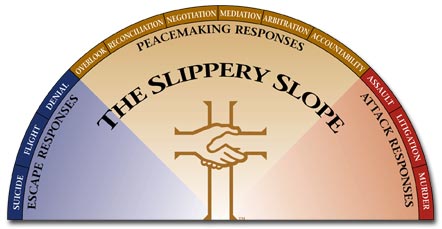
He then sets forth The Slippery Slope of Conflict, which you can see below:

There are three basic ways all people respond to conflict when it arises: escape, attack, and peacemaking. To escape means “[p]eople tend to use these responses when they are more interested in avoiding a conflict than in resolving it” (p.23). It shows up in three different ways:

  1. Denial in pretending a conflict does not exist or refusal to do what is necessary (Gen. 16:1-6; 1 Sam. 2:22-25)
  2. Flight by running away from a conflict (Gen. 16:6-8; 1 Sam. 19:9-10)
  3. Suicide when they lose all hope of resolving a conflict and taking their own life (1 Sam. 31:4)

To attack is in relation to “people who are more interested in winning a conflict than in preserving a relationship” (p.24). These also show up in three different ways:

  1. Assault with different forms of force/intimidation whether verbal, physical or financial (Acts 6:8-15)2.
  2. Litigation by taking them to court (Acts 24:1-26:32; Rom. 13:1-5)3.
  3. Murder by killing those who oppose them (Acts 7:54-58; 1 Jn. 3:15; Mat. 5:21-22)

To make peace is what is “commanded by God, empowered by the gospel, and directed toward finding just and mutually agreeable solutions to conflict” (p.25), which shows up in six ways:

Personal Peacemaking (personal/private)

  1. Overlook an offense in insignificant disputes (Pro. 19:11; 12:16; 17:14; Col. 3:13; 1 Pet. 4:8)
  2. Reconciliation by confession, loving correction, and forgiveness (Mat. 5:23-24; Pro. 28:13; Gal. 6:1; Mat. 18:15; Col. 3:13)
  3. Negotiation by dealing with material issues related to money, property, or other rights, and not just personal ones (Phil. 2:4)

Assisted Peacemaking (outside the conflicted parties)

  1. Mediation by asking one or more objective person(s) outside the conflict to be able to communicate and seek possible solutions (Mat. 18:16)
  2. Arbitration by asking one or more person(s) to hear the cases on both sides and make a decision that is binding (for material cases; 1 Cor. 6:4)
  3. Accountability by involving church leaders to hold one responsible to the word of God in seeking repentance, justice and forgiveness (Mat. 18:17)

Tendencies in failing to resolve conflicts biblically include going from private responses (escape) to public responses (attack). Taking the extreme road on either side leads to death (escape by committing suicide or attack by murdering the other). To escape is to focus on ‘me’ (peace-faker); to attack is to focus on ‘you’ (peace-faker); to go the biblical route is to focus on ‘we’ (peace-maker).

To know how to deal with conflict, we have to look at conflict in a biblical way, which Sande defines as “a difference in opinion or purpose that frustrates someone’s goals or desires” (p.29). The four primary causes are as follows:

  1. Poor communication (Josh. 22:10-34)
  2. Differences in values, goals, gifts, calling, priorities, expectations, interests, or opinions (Acts 15:39; 1 Cor. 12:12-31)
  3. Competition over limited resources, like time or money (Gen. 13:1-12)
  4. Sinful attitudes and habits that lead to sinful words and actions (Jas. 4:1-2)

What is helpful to keep in mind is that there are healthy conflicts that come from a creative God who gifts His people differently, as well as us having personal preferences (1 Cor. 12:21-31), while we pursue unity in the body and not uniformity (Eph. 4:1-13).

From our sinful hearts, many of our conflicts will not that way, and so must look to God’s Word to go about it in a way that is pleasing to Him. By looking at conflicts in a different light, we see that becomes an opportunity to:

Glorify God

  • Trusting Him (Pro. 3:5-7)
  • Obeying Him (Mat. 5:16; Jn. 17:4; Phil. 1:9-10; Jn. 15:8; 14:15-31)
  • Imitating Him (Eph. 5:1-2; 1 Jn. 2:6; Phil. 1:9-11; 1 Pet. 2:12)
  • Acknowledging Him (Phil. 2:13; 1 Pet. 3:14-16)

Serve Others

  • Help an opponent understand his interests and find better solutions than if he sought them by himself (Phil. 2:3-4)
  • Carry your opponents’ burdens by providing for their spiritual, emotional, or material needs (Gal. 6:2, 9-10)
  • Help others learn where they have been wrong and need to change (Gal. 6:1-2)
  • Encourage others to trust in Christ (1 Pet. 3:15-16)
  • Teach and encourage others by your example (1 Cor. 4:12-13, 16; 1 Tim. 4:12; Titus 2:7)

Grow to Be like Christ

  • God uses conflict to make you more like His Son (Rom. 8:28-29; 2 Cor. 12:7-10; Luke 22:41-44)
  • God uses conflict to expose sinful attitudes/habits in your life (Psa. 119:67)
  • God uses conflict to get you to draw on His grace and practice new attitudes/habits

To steward conflicts involves the life of one who “is expected to follow his master’s instructions and look out for his master’s interests, even if they conflict with his own personal desires or convenience” (p.38), which leads to a few character traits he ends the chapter with:

  • Motivated
  • Informed
  • Strengthened
  • Dependent
  • Faithful

Studying the End

by Pastor Patrick Cho

This past Sunday, we met for the first of four Bible studies on end times. It is easy to see why such a topic would generate such great interest. It isn’t an everyday occurrence for people to hear that someone could accurately predict future events. This is one of the most fascinating studies in the Bible. Of course, secular scholars have tried to debunk biblical prophecy for ages. Since they operate from the presupposition that predictive prophecy (or anything else that is miraculous and supernatural) is impossible, they need to find some other solution for it. They postulate that these portions of the Bible were not written when they say they were, but were added later, even though evidence indicates otherwise.

For the believer, this is an essential study. It is important to know what the Bible says about how everything will end. God is the one who began everything, and He has also given us great detail about how it will all end. Here are some basic reasons why studying end times should be pursued by every believer.

First, these portions of Scripture are Scripture. Paul told Timothy that all Scripture is God-breathed and profitable (2 Tim. 3:16). If God decided to reveal something to us in His Word, we would do well to study and learn it. Every believer is to engage in a pursuit of truth. We are to grow deeper and deeper in our understanding of God’s Word and to be diligent to handle it accurately (2 Tim. 2:15). The deeper our understanding of God’s Word, the deeper will be our understanding of God.

Second, knowing the end gives us great confidence as believers to live the Christian life. Christ promised that this world would hate us just as they hated Him (John 15:18). Paul told Timothy that those who seek to live a godly life in Christ will be persecuted (2 Tim. 3:12). The question is left, then, “Is it all worth it?” Having a clear understanding of the future brings greater confidence that the answer is yes. This is why Paul said that if we did not have any hope for the future, we are of all men most to be pitied (1 Cor. 15:19). Who signs up for a difficult life if there is no hope that things will be better in the end?

Third, studying end times gives us a better understanding of the character of God. He is in control. He knows the beginning, and He knows the end. Despite what Open Theism might teach, God does know with absolute certainty what will happen tomorrow. The Psalmist wrote that God knew all his days even before he saw one of them (Ps. 139:16). The greater our appreciation of God, the deeper our worship of Him will be.

Fourth, knowing what the Bible says about end times gives us greater urgency to tell people about Jesus. This life is short to begin with. That is one of the major themes of Psalm 90. Man is transitory, but God is eternal. But, aside from the fact that life is short, Jesus is also coming quickly (Rev. 22:20; cf. 2 Pet. 3:9). Indeed, He could come today. Knowing that our time is limited drives us to share the gospel with those around us, and especially with those we love.

Fifth, understanding the end motivates us to live holy lives. When I was a kid, sometimes I would do things I wasn’t supposed to do (I won’t give any details). But I always made sure that I wasn’t doing those things around the time that my parents would come home. Why? Because I didn’t want to get in trouble, but also because I didn’t want to suffer the shame of being caught in it. Those who live with the realization that Jesus could come today probably will not comfortably allow sin to be in their lives. Those who live as though the Lord will tarry for sure might be more at ease to fall into the temptations of this world and sin. Having a good understanding of the future is the basis behind leading righteous lives in the present (cf. 1 Cor. 15:58).

Finally, understanding what happens in the end will keep our priorities in the right place. Jesus told His disciples to store up treasure in heaven, and not on earth (Matt. 6:20-21). Those who live as though this life is all there is will invest everything they have into this life. They will pursue the pleasures of this world (which are not all evil necessarily). They will make their lives all about pursuing pleasure, seeing the world, and living and dying comfortably. Those who have a clear sense that this life is not the end will invest what they have in the life to come. Compared to eternity, what is our existence here on earth?

For these reasons (and many more!), I wanted to conduct that evening study on end times. Hopefully all the members of the church will be able to come out and benefit from it. For those who came out on Sunday, hopefully it wasn’t too confusing, fast, or frustrating! As long as we have God’s Word, let’s not slow down in our pursuit to know it from cover to cover.

What is the Vine Tree More Than Any Tree…

by Charles Haddon Spurgeon

From Ezekiel 15:2

These words are for the humbling of God’s people; they are called God’s vine, but what are they by nature more than others? They, by God’s goodness, have become fruitful, having been planted in a good soil; the Lord hath trained them upon the walls of the sanctuary, and they bring forth fruit to His glory; but what are they without their God? What are they without the continual influence of the Spirit, begetting fruitfulness in them?

O believer, learn to reject pride, seeing that thou hast no ground for it. Whatever thou art, thou hast nothing to make thee proud. The more thou hast, the more thou art in debt to God; and thou shouldst not be proud of that which renders thee a debtor. Consider thine origin; look back to what thou wast. Consider what thou wouldst have been but for divine grace. Look upon thyself as thou art now. Doth not thy conscience reproach thee? Do not thy thousand wanderings stand before thee, and tell thee that thou art unworthy to be called His son? And if He hath made thee anything, art thou not taught thereby that it is grace which hath made thee to differ?

Great believer, thou wouldst have been a great sinner if God had not made thee to differ. O thou who art valiant for truth, thou wouldst have been as valiant for error if grace had not laid hold upon thee. Therefore, be not proud, though thou hast a large estate-a wide domain of grace, thou hadst not once a single thing to call thine own except thy sin and misery. Oh! strange infatuation, that thou, who hast borrowed everything, shouldst think of exalting thyself; a poor dependent pensioner upon the bounty of thy Saviour, one who hath a life which dies without fresh streams of life from Jesus, and yet proud! Fie on thee, O silly heart!

1.22a